Computational Algorithms for Predicting Jamming Phase Transitions in Stochastic Fiber Networks

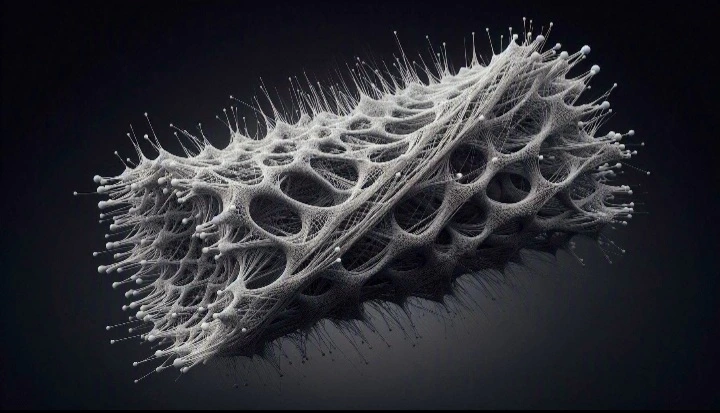
Introduction to Stochastic Fiber Networks Stochastic fiber networks represent a highly complex class of mechanical metamaterials where the spatial distribution, orientation, and entanglement of constituent fibers are governed by probabilistic distributions rather than deterministic geometric blueprints. Unlike woven or braided architectures, which possess repeating unit cells and predictable load paths, stochastic networks—such as non-woven felts, … Read more


Morphological Computation and Programmable Stiffness in Origami-Inspired Crocheted Tessellations

Introduction to Origami-Inspired Tessellations in Textiles The intersection of origami mathematics and advanced textile engineering has catalyzed the development of a novel class of mechanical metamaterials: origami-inspired crocheted tessellations. Traditional origami relies on the continuous folding of a two-dimensional, inextensible manifold to create complex, deployable three-dimensional architectures. When this mathematical framework is translated into the … Read more

Energy Absorption and Impact Dynamics in Hierarchical Weft-Knitted Auxetic Metamaterials

Introduction to Weft-Knitted Auxetic Metamaterials The pursuit of advanced impact-resistant materials has increasingly focused on the unique mechanical properties of auxetic metamaterials. Characterized by a negative Poisson’s ratio, these structures exhibit the counter-intuitive behavior of expanding transversely when subjected to longitudinal tension, and conversely, contracting transversely under compression. When this auxetic behavior is engineered into … Read more

Topological Invariants and Knot Theory Applications in Multi-Axial Crocheted Tensegrity Structures

Introduction to Crocheted Tensegrity Systems The architectural paradigm of tensegrity—a portmanteau of tensional integrity—has traditionally been defined by a system of isolated, rigid compressive elements (struts) suspended within a continuous network of flexible tensile elements (cables). This structural principle yields highly resilient, lightweight frameworks capable of distributing localized stresses globally across the entire geometric matrix. … Read more

Topology Optimization of 3D-Woven Preforms for Enhanced Out-of-Plane Impact Resistance

Introduction to 3D-Woven Preforms The engineering of advanced composite materials for aerospace, ballistic, and high-performance automotive applications has historically relied on two-dimensional laminated structures. While these materials offer exceptional in-plane specific strength and stiffness, their susceptibility to out-of-plane impact and subsequent delamination remains a critical structural vulnerability. To address this, the field of textile engineering … Read more

Bifurcation Analysis of Auxetic Instabilities in Chiral Crocheted Lattices Subjected to Biaxial Tension

Introduction to Chiral Crocheted Metamaterials The engineering of mechanical metamaterials has increasingly focused on the exploitation of complex geometric architectures to achieve non-conventional macroscopic properties. Among these, topologically interlocked fibrous networks, specifically those fabricated via advanced crocheting techniques, offer a unique platform for developing highly compliant, energy-dissipating structures. Unlike traditional woven or braided composites, where … Read more

Non-Linear Mechanics of Helical Yarn Entanglement in Triply Periodic Minimal Surface (TPMS) Architectures

Introduction to TPMS Architectures in Fibrous Networks The conceptualization of Triply Periodic Minimal Surfaces (TPMS) has historically been confined to the realms of differential geometry, crystallography, and the study of lipid bilayers in biological systems. A minimal surface is defined mathematically as a surface that locally minimizes its area for a given boundary, possessing a … Read more

Geometric Frustration and Defect Propagation in Kagome-Lattice Crocheted Metamaterials

Introduction to Kagome-Lattice Metamaterials The architectural translation of the Kagome lattice—a trihexagonal tiling traditionally studied in the context of condensed matter physics and quantum spin liquids—into macroscopic crocheted metamaterials represents a frontier in advanced structural engineering. A Kagome lattice is composed of interlaced triangles and hexagons, creating a highly coordinated network that is inherently predisposed … Read more

Kinematic Modeling of Jamming Phase Transitions in Densely Packed Crocheted Metamaterials

Introduction to Crocheted Metamaterials and Topological Interlocking The field of mechanical metamaterials has witnessed a paradigm shift with the introduction of topologically interlocked fibrous networks. Unlike conventional composite materials, where macroscopic mechanical properties are dictated by the intrinsic chemical composition and the adhesive bonding of the constituent phases, mechanical metamaterials derive their anomalous behaviors from … Read more

Algorithmic Modeling of Auxetic Yarn Extrusion Protocols

Fig.1 – CFD simulation of non-Newtonian polymer melt velocity vectors during capillary extrusion. Theoretical Framework of Auxetic Kinematics and Extrusion Rheology Auxetic metamaterials represent a profound paradigm shift within the domain of topological interlocking structures. These materials are mathematically defined by a negative Poisson’s ratio, a kinematic property that dictates transverse macroscopic expansion when subjected … Read more