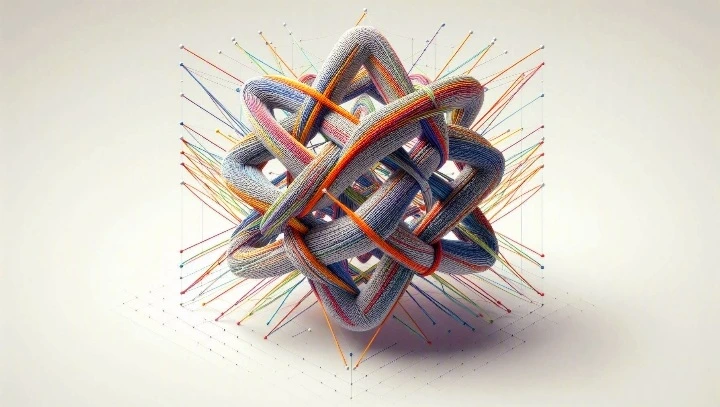
Introduction to Crocheted Tensegrity Systems
The architectural paradigm of tensegrity—a portmanteau of tensional integrity—has traditionally been defined by a system of isolated, rigid compressive elements (struts) suspended within a continuous network of flexible tensile elements (cables). This structural principle yields highly resilient, lightweight frameworks capable of distributing localized stresses globally across the entire geometric matrix. However, the translation of macroscopic tensegrity concepts into continuous, monolithic textile architectures represents a formidable challenge in advanced fiber science. Multi-axial crocheted tensegrity structures offer a revolutionary solution to this challenge. By utilizing a single, continuous polymeric filament, engineers can fabricate a complex three-dimensional manifold where the traditional rigid struts are replaced by highly densified, topologically interlocked knots, and the tensile cables are represented by the unentangled yarn segments connecting these nodal junctions. The mechanical behavior of these structures is not governed by the intrinsic compressive strength of a distinct material phase, but rather by the kinematic confinement and geometric frustration inherent to the crocheted topology. Understanding the fundamental mechanics of these advanced fibrous networks requires a rigorous departure from classical continuum mechanics, necessitating the application of abstract mathematical frameworks, specifically knot theory and the analysis of topological invariants. This treatise provides a comprehensive examination of how topological invariants dictate the macroscopic mechanical properties, energy dissipation capabilities, and structural stability of multi-axial crocheted tensegrity metamaterials.
The Tensegrity Paradigm in Fibrous Networks
In a conventional tensegrity structure, the dichotomy between tension and compression is absolute and material-dependent. In a multi-axial crocheted tensegrity network, this dichotomy is achieved purely through topological programming. The continuous polymeric filament, typically spun from high-modulus materials such as ultra-high molecular weight polyethylene or liquid crystal polymers, is inherently flexible and incapable of supporting significant compressive loads in its linear state. However, when the filament is iteratively looped and drawn through itself to form a dense crocheted node, the localized geometry fundamentally alters the load-bearing mechanics. As macroscopic tension is applied to the network, the yarn segments between the nodes stretch, transferring the load to the interlocking loops. These loops are drawn tightly together, resulting in a massive increase in transverse compressive stress at the inter-fiber contact points. This strain-induced densification transforms the compliant knot into a highly rigid, load-bearing pseudo-strut. The tensegrity principle is thus realized: a continuous network of tensioned filaments suspending discrete, self-generated zones of extreme compression. The stability of this system is entirely dependent on the precise spatial arrangement and the specific topological interlocking of the constituent knots, which prevent the structure from collapsing into a zero-volume state under external loading.
Multi-Axial Crocheting as a Fabrication Methodology
The physical realization of these complex tensegrity networks relies on advanced multi-axial crocheting techniques. Traditional crocheting is largely a two-dimensional process, creating planar fabrics through the sequential interlocking of loops in a single plane. Multi-axial crocheting, facilitated by robotic fabrication systems and multi-needle end-effectors, transcends this limitation by allowing the continuous filament to traverse three-dimensional space, interlocking with previously established nodes along orthogonal and diagonal axes. This volumetric fabrication methodology enables the creation of highly isotropic or specifically tailored anisotropic metamaterials. The robotic control systems must execute precise, mathematically defined trajectories to ensure that the correct topological links are formed at each nodal intersection. A single deviation in the looping sequence—a missed interlock or an inverted crossing—can fundamentally alter the topological invariant of the node, transforming a stable tensegrity strut into a compliant, unjammed loop. Consequently, the manufacturing process is inextricably linked to the mathematical rigorousness of knot theory, requiring computational algorithms to translate abstract topological diagrams into executable machine code for the robotic fabrication of the physical metamaterial.
Knot Theory and Topological Invariants
To predict and control the mechanical response of a multi-axial crocheted tensegrity structure, one must mathematically quantify the complexity of its interlocking nodes. Knot theory, a branch of algebraic topology, provides the necessary analytical framework. In mathematical terms, a knot is defined as an embedding of a one-dimensional circle into three-dimensional Euclidean space. Because a crocheted network is formed from a continuous filament, the individual nodes are more accurately described as links—a collection of multiple intertwined knots. The fundamental challenge in analyzing these structures is determining whether two seemingly different physical configurations of a yarn are, in fact, topologically identical. This is achieved through the calculation of topological invariants—mathematical properties that remain constant regardless of how the knot or link is physically deformed, stretched, or twisted, provided the filament is not severed and reconnected.
Mathematical Formalism of Knots and Links
The mathematical formalism of knots and links in textile structures relies heavily on the concept of ambient isotopy. Two crocheted nodes are considered ambient isotopic if one can be continuously deformed into the other without the filament passing through itself. In the physical realm of the tensegrity structure, this equates to the geometric reorganization of the loops under applied strain. As the structure deforms, the physical geometry of the knot changes drastically, but its underlying topology remains invariant. To analyze this topology, the three-dimensional knot is projected onto a two-dimensional plane, creating a knot diagram characterized by a series of over-crossings and under-crossings. The German mathematician Kurt Reidemeister proved that any two knot diagrams representing the same ambient isotopic knot can be transformed into one another through a sequence of three fundamental localized modifications, known as Reidemeister moves. Type I involves twisting or untwisting a single loop; Type II involves moving one loop completely over another; and Type III involves sliding a strand over a crossing. By applying these moves to the knot diagrams of the crocheted nodes, engineers can simplify the complex entanglements and identify the core topological structure that dictates the kinematic confinement of the tensegrity pseudo-strut.
Polynomial Invariants in Structural Classification
While Reidemeister moves provide a theoretical method for proving topological equivalence, they are computationally inefficient for classifying the highly complex links found in multi-axial crocheted metamaterials. Instead, researchers utilize polynomial invariants, such as the Alexander polynomial, the Jones polynomial, and the HOMFLYPT polynomial. These algebraic expressions are derived from the crossing patterns of the knot diagram and serve as a unique mathematical fingerprint for the specific topology. The Jones polynomial, in particular, is highly sensitive to the chirality (handedness) of the knot, a critical factor in determining the auxetic behavior (negative Poisson’s ratio) of the macroscopic tensegrity structure. By calculating the polynomial invariant for a specific crocheted node, materials scientists can predict its mechanical behavior without the need for exhaustive empirical testing. For instance, a node characterized by a highly complex polynomial invariant will possess a higher crossing number, indicating a greater degree of kinematic confinement and a higher potential for strain-induced densification. This mathematical classification allows for the deterministic design of tensegrity structures, where specific topological invariants are strategically placed within the multi-axial matrix to program localized stiffness, energy dissipation, and failure pathways.
Mechanics of Topological Interlocking
The translation of abstract topological invariants into tangible mechanical properties is governed by the physics of topological interlocking. In a multi-axial crocheted tensegrity structure, the continuous filament is kinematically confined by its own geometry. The mechanical response of the structure is not dictated by the stretching of the polymer chains, but by the complex, non-affine reorganization of the interlocking loops and the massive frictional forces generated at the nodal crossings.
Kinematic Confinement and Load Distribution
When a macroscopic load is applied to the crocheted tensegrity network, the initial response is highly compliant. The unentangled yarn segments (the tensile cables) straighten, and the interlocking loops at the nodes undergo rigid body translation and rotation to align with the principal axis of loading. This geometric reorganization is governed by the topological invariant of the node; a knot with a higher crossing number possesses less free volume and will exhaust its kinematic mobility more rapidly. As the loops impinge upon one another, the node enters a jammed state. The kinematic confinement prevents any further geometric reorganization, and the applied load is transferred directly into the transverse compression of the polymeric filament. This jamming transition is the mechanism by which the flexible yarn transforms into a rigid compressive strut. The spatial distribution of these jammed nodes dictates the global load transfer pathways through the tensegrity matrix. Because the structure is continuous, a localized impact load is rapidly distributed outward, propagating through the network of tensioned cables and being absorbed by the sequential jamming of adjacent topological nodes, thereby preventing catastrophic localized failure.
Frictional Interactions and Energy Dissipation
The ultimate load-bearing capacity and the energy dissipation profile of the crocheted tensegrity structure are entirely dependent on the frictional interactions at the topologically interlocked nodes. As the node jams and the transverse compressive forces increase, the frictional resistance between the overlapping yarn segments rises exponentially. This tribological behavior is characterized by complex stick-slip dynamics. When the localized shear stress at a crossing exceeds the static frictional resistance, the yarns slip past one another, dissipating a massive amount of stored strain energy as heat. This slip is quickly arrested as the yarns encounter new geometric constraints dictated by the knot topology, leading to a continuous cycle of sticking and slipping. The total energy dissipated during an impact event is directly proportional to the crossing number of the topological invariant; more crossings equate to a larger frictional contact area and a higher capacity for energy absorption. Furthermore, the surface morphology of the constituent filament plays a critical role. Filaments engineered with specific nanoscale roughness or viscoelastic coatings can significantly enhance the coefficient of friction, thereby increasing the macroscopic yield strength and the fracture toughness of the tensegrity metamaterial.
Computational Modeling and Empirical Validation
The extreme non-linearity, large-deformation kinematics, and complex contact mechanics of multi-axial crocheted tensegrity structures necessitate a highly sophisticated approach to structural analysis. The integration of advanced computational modeling with rigorous empirical testing is essential for validating the theoretical predictions derived from topological invariants and knot theory.
Finite Element Analysis of Knotted Nodes
Finite Element Analysis (FEA) provides the computational framework required to simulate the micro-mechanical behavior of the topologically interlocked nodes. Due to the computational expense of modeling an entire macroscopic tensegrity matrix, FEA is typically applied to representative volume elements or individual knotted unit cells. The geometric model of the unit cell is generated directly from the mathematical knot diagram, ensuring absolute topological fidelity. The constituent polymeric yarns are modeled using advanced hyperelastic or viscoplastic constitutive equations that account for the distinct axial and transverse properties of the highly drawn polymer. The most critical aspect of the FEA simulation is the implementation of robust penalty-based contact algorithms to handle the massive number of self-intersections and the pressure-dependent frictional sliding at the crossings. These simulations reveal the highly heterogeneous stress distribution within the jammed node, identifying the specific locations of maximum transverse compression and the onset of localized plastic yielding or fibrillar failure.
Mechanical Testing and Failure Modes
The empirical characterization of these structures requires specialized multi-axial testing protocols to capture the complex tensegrity dynamics. Standard uniaxial testing is insufficient, as it artificially constrains the lateral deformation and suppresses the natural kinematic reorganization of the network. Biaxial or triaxial testing apparatuses, integrated with high-speed Digital Image Correlation (DIC) systems, are utilized to map the full-field strain distribution and identify the precise moment of the jamming transition. The empirical data is then correlated with the topological invariants of the constituent nodes to establish a predictive framework for structural performance. The following table delineates the relationship between specific topological classifications, their mathematical crossing numbers, and the resulting mechanical response characteristics observed during empirical testing.
| Topology Classification | Minimum Crossing Number | Mechanical Response Characteristics |
|---|---|---|
| Torus Knots (T_p,q) | 3 (Trefoil Knot) |
|
| 5 (Cinque Foil Knot) |
|
|
| Twist Knots | 4 (Figure-Eight Knot) |
|
| 6 (Stevedore Knot) |
|
Advanced Applications and Future Trajectories
The ability to program the macroscopic mechanical properties of a continuous fibrous network through the deterministic placement of specific topological invariants opens up a vast array of advanced applications across multiple engineering disciplines. The multi-axial crocheted tensegrity structure represents a paradigm shift in the design of lightweight, highly resilient metamaterials.
Aerospace and Deployable Structures
In the aerospace sector, the demand for ultra-lightweight structures that can be compactly stowed during launch and reliably deployed in orbit is paramount. Crocheted tensegrity metamaterials are uniquely suited for this application. Prior to the application of tension, the structure is highly compliant and can be folded into a fraction of its operational volume. Once in orbit, the deployment mechanism applies tension to the continuous filament network. The topologically programmed nodes undergo their kinematic reorganization and jam, instantly transforming the flaccid fabric into a highly rigid, dimensionally stable tensegrity framework. This technology is currently being investigated for the development of massive deployable parabolic antennas, solar sail booms, and micrometeoroid impact shields. In the context of impact shielding, the high crossing number topologies (such as the Stevedore knot) are strategically placed on the outermost layers to maximize energy dissipation and shatter incoming projectiles, while lower crossing number topologies are utilized in the underlying layers to absorb the residual kinetic energy through macroscopic structural deformation.
Biomedical Scaffolding and Soft Robotics
Beyond aerospace, the principles of topological interlocking and knot theory are being applied to the biomedical field, specifically in the design of advanced endovascular stents and tissue engineering scaffolds. A crocheted tensegrity stent can be compressed to a microscopic diameter for catheter delivery. Upon reaching the target vessel, the removal of the compressive sheath allows the stent to expand. The specific topological invariants of the crocheted nodes are engineered to jam at a precise radial diameter, providing optimal support to the vessel walls without exerting excessive outward pressure that could cause tissue damage. Furthermore, in the rapidly evolving field of soft robotics, these tensegrity networks are utilized to create adaptive actuators. By integrating stimuli-responsive yarns—such as shape-memory alloys or liquid crystal elastomers—into the multi-axial crocheted matrix, engineers can actively control the jamming transition of the topological nodes. Applying a thermal or electrical stimulus causes the yarn to contract, artificially inducing the tensegrity state and allowing the soft robotic appendage to transition instantaneously from a flexible, compliant state to a rigid, load-bearing manipulator. The continued convergence of knot theory, computational topology optimization, and advanced robotic manufacturing will undoubtedly unlock new frontiers in the engineering of these extraordinary fibrous metamaterials.