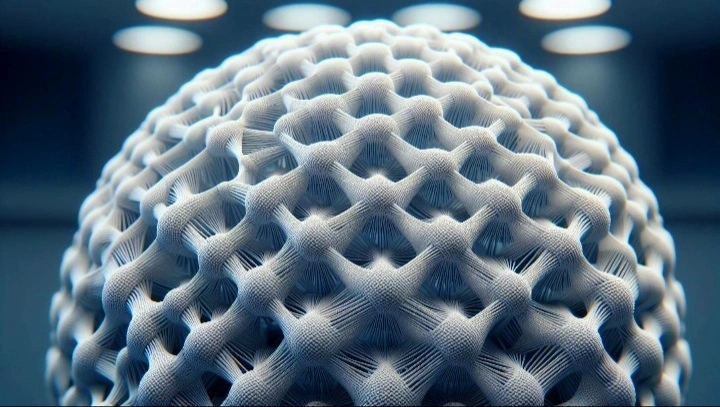
Introduction to Kagome-Lattice Metamaterials
The architectural translation of the Kagome lattice—a trihexagonal tiling traditionally studied in the context of condensed matter physics and quantum spin liquids—into macroscopic crocheted metamaterials represents a frontier in advanced structural engineering. A Kagome lattice is composed of interlaced triangles and hexagons, creating a highly coordinated network that is inherently predisposed to complex mechanical behaviors. When this geometry is physically realized through the continuous, topologically interlocked loops of a crocheted textile, the resulting metamaterial exhibits extraordinary non-linear mechanical properties. Unlike conventional woven fabrics, which rely on the orthogonal interlacing of distinct warp and weft yarns, a crocheted Kagome metamaterial is fabricated from a single continuous filament. This filament is iteratively looped to form the characteristic triangular and hexagonal voids. The structural integrity of this matrix is not derived from chemical adhesion or rigid nodal bonding, but entirely from the kinematic confinement of the interlocking loops. As external loads are applied, these loops undergo significant geometric reorganization, translating, rotating, and impinging upon one another. This dynamic reorganization is heavily influenced by the unique topology of the Kagome lattice, which introduces a profound degree of geometric frustration into the mechanical response. The study of these structures requires a departure from classical continuum mechanics, necessitating discrete element methodologies that can accurately capture the highly localized deformations and the shifting contact mechanics at the interlocking nodes. As articulated by Dr. H. V. Konda in his seminal research on topological mechanics, the true potential of the Kagome architecture lies not in its static symmetry, but in its dynamic response to localized stress, where geometric frustration dictates the macroscopic energy dissipation.
Consequently, understanding the precise mechanisms of defect nucleation and propagation within these frustrated lattices is paramount for the optimization of next-generation impact-resistant textiles and adaptive aerospace structures.
The Principle of Geometric Frustration
Geometric frustration is a concept originally developed to describe the behavior of magnetic spin systems, such as water ice or spin glasses, where the geometric arrangement of the atoms prevents the system from simultaneously minimizing all of its local interaction energies. In a triangular lattice with antiferromagnetic interactions, for example, it is impossible for all three spins in a triangle to be anti-aligned with their neighbors; the geometry inherently frustrates the system, leading to a massive degeneracy of ground states and highly complex, non-trivial behaviors at low temperatures. When this concept is translated into the realm of mechanical metamaterials, specifically within the Kagome-lattice crocheted architecture, frustration manifests as a kinematic incompatibility during macroscopic deformation. As a compressive or tensile load is applied to the metamaterial, the individual interlocking loops attempt to rotate and translate to minimize their localized strain energy. However, the trihexagonal geometry dictates that the optimal kinematic displacement for one loop is often in direct conflict with the optimal displacement of its immediate neighbors. The loops are mechanically frustrated, unable to reach a globally relaxed state. This geometric frustration prevents the lattice from deforming via simple, affine transformations. Instead, the metamaterial must accommodate the applied strain through highly complex, non-affine internal reorganizations. This localized buckling, twisting, and out-of-plane deformation of the continuous filament absorbs a tremendous amount of mechanical energy. The frustrated nature of the lattice ensures that stress cannot easily propagate along straight, continuous pathways; it is constantly redirected and dispersed by the conflicting kinematic constraints of the triangular and hexagonal nodes.
The manifestation of geometric frustration in macroscopic mechanical systems fundamentally alters the pathways of energy dissipation, transforming localized stress concentrations into distributed, non-affine kinematic reorganizations that exponentially increase the apparent fracture toughness of the metamaterial.
The mechanical frustration inherent in the Kagome topology also leads to the emergence of localized, zero-frequency deformation modes, often referred to as floppy modes. In an ideal, pin-jointed Kagome framework, these floppy modes allow the structure to undergo macroscopic deformation without stretching or compressing any of the constituent struts. In a crocheted realization, the loops are not perfect pin joints; they possess finite bending and torsional stiffness. Therefore, the floppy modes are not entirely zero-energy, but they represent pathways of exceptionally low mechanical resistance. The interplay between these low-energy deformation modes and the high-energy frictional interactions at the interlocking nodes dictates the highly non-linear, strain-stiffening behavior of the metamaterial.
Topological Interlocking in Crocheted Networks
The physical realization of a Kagome lattice through crocheting introduces a secondary layer of complexity: topological interlocking. In a theoretical Kagome framework, the nodes are typically modeled as mathematical points or rigid hinges. In a crocheted metamaterial, the nodes are complex, three-dimensional entities formed by the mutual interlooping of a continuous polymeric filament. This topological interlocking means that the structural integrity of the lattice is derived entirely from the physical volume and the non-penetration constraints of the yarn. The loops cannot pass through one another; they are kinematically confined. This confinement is highly sensitive to the initial packing density of the lattice and the specific morphology of the crochet stitch utilized. When the geometrically frustrated Kagome lattice attempts to deform, the interlocking loops are forced into tight, frictional contact. The transverse compressive forces at these nodal intersections increase dramatically, effectively locking the loops in place and transitioning the metamaterial from a highly compliant, fluid-like state to a rigid, solid-like state. This phenomenon, closely related to the jamming phase transition observed in granular media, is the primary mechanism for load bearing in these structures.
In strictly topological interlocking assemblies, the absence of chemical or adhesive binders necessitates that all structural integrity is derived exclusively from the kinematic constraints imposed by the geometric morphology of the individual elements, a condition that is dynamically amplified by the inherent frustration of the Kagome topology.
The continuous nature of the filament in a crocheted network also means that the topological interlocking is non-local. A displacement or a localized failure at one node inevitably alters the tension and the spatial configuration of the filament at adjacent nodes. This non-local coupling significantly complicates the analysis of defect propagation. If a single loop is severed, the loss of tension causes the surrounding loops to relax and reorient, potentially unjamming a localized region of the lattice. However, because the structure is topologically interlocked, the failure does not immediately propagate as a catastrophic crack. The surrounding intact loops, driven by the geometric frustration of the Kagome architecture, redistribute the load, isolating the defect and maintaining the global integrity of the metamaterial. The precise mechanics of this load redistribution are governed by the frictional stick-slip dynamics at the interlocking nodes, necessitating advanced computational models to accurately predict the ultimate failure strength of the composite.
Defect Nucleation Mechanisms
The performance of Kagome-lattice crocheted metamaterials is inextricably linked to the presence and the propagation of structural defects. Unlike crystalline solids, where defects are typically defined at the atomic scale, defects in crocheted metamaterials occur at the mesoscopic scale of the unit cell. Defect nucleation can occur during the manufacturing process or as a result of applied mechanical stress. Manufacturing defects often manifest as topological faults—errors in the crocheting sequence that alter the local connectivity of the lattice. For example, a missed loop or an extra twist in the filament disrupts the perfect trihexagonal symmetry, creating a localized region with a different coordination number and altered kinematic constraints. These topological faults act as severe stress concentrators. When the metamaterial is subjected to an external load, the geometric frustration is amplified at these defect sites, leading to premature localized yielding and the initiation of structural failure.
Stress-induced defect nucleation, on the other hand, typically involves the mechanical rupture of the continuous filament or the irreversible frictional slip of an interlocking node. Under extreme tensile or compressive loading, the localized stresses at the nodal intersections can exceed the ultimate tensile strength or the transverse crush strength of the polymeric yarn. Because the Kagome lattice is geometrically frustrated, the stress distribution is highly heterogeneous. Certain nodes will experience massive stress concentrations while adjacent nodes remain relatively unloaded. This heterogeneity dictates that defect nucleation is a highly localized phenomenon. Once a filament ruptures, a mesoscopic vacancy is created within the lattice. The kinematic constraints on the surrounding loops are suddenly released, leading to a rapid, localized geometric reorganization. The energy released during this nucleation event must be absorbed by the surrounding lattice, initiating a complex cascade of stress redistribution that can either stabilize the defect or drive its propagation through the metamaterial.
Propagation Dynamics and Structural Failure
The propagation of defects through a Kagome-lattice crocheted metamaterial deviates significantly from the classical fracture mechanics observed in continuous media. In a homogeneous, isotropic material, a crack propagates when the stress intensity factor at the crack tip exceeds the fracture toughness of the material, typically resulting in a linear, catastrophic failure. In a topologically interlocked, geometrically frustrated lattice, defect propagation is a highly non-linear, discontinuous process characterized by avalanche dynamics and localized structural arrest. When a mesoscopic defect nucleates—such as the rupture of a single interlocking loop—the immediate consequence is a localized loss of kinematic confinement. The surrounding loops, previously held in a jammed state by the mutual impingement of the severed filament, are suddenly free to translate and rotate. This localized unjamming event redistributes the applied load to the adjacent intact nodes. However, because the Kagome lattice is geometrically frustrated, this redistributed load does not propagate evenly. Instead, it is channeled along specific, tortuous pathways determined by the instantaneous kinematic configuration of the surrounding loops.
As the load is transferred, the adjacent nodes experience a sudden spike in transverse compressive stress and inter-fiber friction. If this localized stress exceeds the failure threshold of the filament, a secondary defect nucleates, and the structural fault advances. However, the topological interlocking of the crocheted architecture frequently arrests this propagation. As the surrounding loops reorient to accommodate the redistributed load, they often jam into new, highly stable configurations, effectively blunting the crack tip and halting the progression of the failure. This phenomenon, known as defect trapping, is a direct consequence of the geometric frustration inherent to the Kagome topology. The lattice must undergo a massive, non-affine geometric reorganization to bypass this trapped state, requiring a significant increase in the applied global strain. Consequently, the macroscopic failure of the metamaterial is not characterized by a single, continuous crack, but by a series of discrete, localized rupture events—avalanches of micro-failures separated by periods of structural stability and strain hardening.
The ultimate failure of geometrically frustrated, topologically interlocked metamaterials is governed by avalanche dynamics, wherein localized defect propagation is continuously arrested by the spontaneous jamming of adjacent nodes, resulting in a highly non-linear, step-wise degradation of macroscopic structural integrity.
The precise dynamics of these failure avalanches are heavily dependent on the strain rate and the inherent viscoelastic properties of the polymeric filament. At low strain rates, the polymer chains within the yarn have sufficient time to undergo stress relaxation, mitigating the localized stress concentrations at the interlocking nodes and promoting defect trapping. The metamaterial exhibits extreme ductility and a high capacity for energy dissipation. Conversely, at high strain rates, such as those experienced during a ballistic impact, the viscoelastic relaxation is suppressed. The polymeric filament behaves in a more brittle manner, and the localized stress concentrations rapidly exceed the ultimate tensile strength of the yarn. The defect propagation transitions from a discontinuous, avalanche-like process to a more rapid, catastrophic failure mode. Nevertheless, even under high-velocity impact, the geometric frustration and the topological interlocking of the Kagome lattice ensure that the energy dissipation is significantly higher than that of a conventional woven fabric. The complex, tortuous pathways of force percolation and the massive frictional energy dissipated during the localized unjamming and re-jamming of the loops make these crocheted metamaterials exceptionally promising for advanced protective applications. Future research must focus on the development of multi-scale computational models capable of accurately simulating these discrete avalanche dynamics, enabling the precise engineering of defect tolerance in next-generation aerospace and ballistic structures.