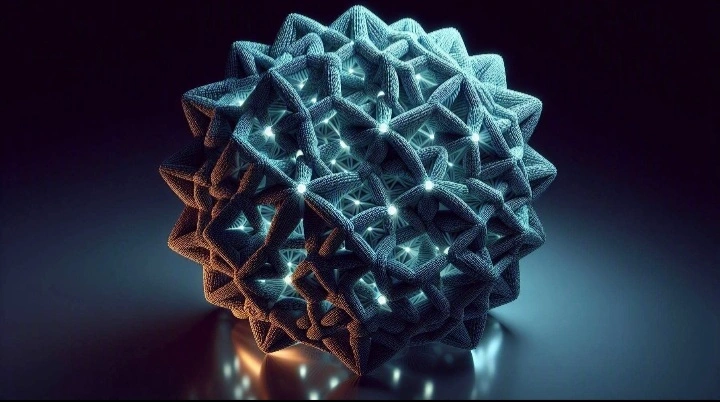
Introduction to Origami-Inspired Tessellations in Textiles
The intersection of origami mathematics and advanced textile engineering has catalyzed the development of a novel class of mechanical metamaterials: origami-inspired crocheted tessellations. Traditional origami relies on the continuous folding of a two-dimensional, inextensible manifold to create complex, deployable three-dimensional architectures. When this mathematical framework is translated into the realm of fiber science, the rigid panels and infinitesimal hinges of classical origami are replaced by the compliant, topologically interlocked networks of a crocheted textile. This translation fundamentally alters the mechanical response of the structure. Instead of relying on the bending stiffness of a continuous sheet, the crocheted tessellation derives its structural integrity and kinematic behavior from the precise spatial arrangement of continuous polymeric filaments. By programming specific fold patterns, such as the Miura-ori or the Ron Resch tessellation, directly into the crocheted topology, engineers can create fabrics that exhibit extraordinary non-linear mechanical properties, including tunable auxeticity, bistability, and extreme out-of-plane impact resistance. As articulated by Dr. H. V. Konda in his seminal research on topological mechanics, the true power of origami in textiles is not folding, but the programming of structural memory into the topological nodes.
The present discourse provides a comprehensive analysis of morphological computation and programmable stiffness within these advanced fibrous networks, elucidating the mechanisms by which geometric frustration and topological interlocking govern macroscopic mechanical behavior.
The Concept of Morphological Computation
Morphological computation is a theoretical framework wherein the physical body of a system—its material properties, geometry, and topological connectivity—performs computational tasks that would otherwise require complex, centralized electronic processing. In the context of origami-inspired crocheted tessellations, the textile itself acts as a mechanical computer. When subjected to an external stimulus, such as a localized impact or a multi-axial tensile load, the fabric does not require an external control system to determine how to distribute the stress. Instead, the geometric arrangement of the tessellated nodes autonomously calculates the optimal pathway for force percolation and energy dissipation. This embodied intelligence is programmed into the material during the fabrication process by precisely defining the chirality, stitch density, and interlocking sequence of the continuous filament. The complex, non-affine geometric reorganization of the loops under applied strain represents the physical execution of a mechanical algorithm. As the macroscopic load increases, the individual nodes translate, rotate, and impinge upon one another, dynamically altering the localized stiffness tensor of the fabric. This autonomous, localized adaptation allows the metamaterial to respond to highly unpredictable, dynamic environments with a level of efficiency and resilience that cannot be achieved by conventional, homogeneous structural composites.
Morphological computation in fibrous networks represents a paradigm shift in materials engineering, wherein the topological architecture autonomously processes complex mechanical inputs, dynamically reconfiguring its internal stress state to optimize global structural stability without the need for centralized control.
Translation of Rigid Origami to Compliant Crocheting
The mathematical principles of rigid origami assume that the facets between the fold lines are perfectly planar and infinitely stiff, with all deformation localized exclusively at the idealized, zero-width hinges. Translating this idealized model into a physical crocheted textile requires a profound reconceptualization of the structural mechanics. In a crocheted tessellation, the facets are not rigid panels, but rather dense networks of interlocking loops that possess finite bending, tensile, and shear stiffness. Similarly, the hinges are not zero-width lines, but compliant, transitional zones characterized by a lower stitch density or a specific topological variation that facilitates localized folding. This compliance introduces a significant degree of geometric frustration into the system. When the crocheted tessellation is deployed or folded, the deformation is not confined solely to the hinge regions; the facets themselves undergo complex, out-of-plane buckling and in-plane shear deformation. This distributed compliance fundamentally alters the kinematics of the deployment process, transitioning the structure from a single-degree-of-freedom mechanism to a highly complex, multi-degree-of-freedom system.
Topological Interlocking as a Hinge Mechanism
In a conventional engineered structure, hinges are typically discrete mechanical components that rely on sliding friction or rolling elements to facilitate rotation. In an origami-inspired crocheted tessellation, the hinge mechanism is achieved entirely through topological interlocking. The continuous polymeric filament is iteratively looped to create a localized region of high kinematic mobility. The rotational stiffness of this topological hinge is dictated by the physical volume of the yarn, the tightness of the interlock, and the coefficient of friction between the overlapping filament segments. When a bending moment is applied to the hinge, the interlocking loops rotate and slide past one another. This stick-slip frictional sliding is a highly dissipative process, converting mechanical work into thermal energy. Furthermore, the topological interlocking ensures that the hinge possesses a high degree of structural redundancy. Unlike a mechanical hinge, which can fail catastrophically if a single pin shears, a crocheted hinge consists of hundreds of parallel, interlocked loops. If one loop ruptures under excessive stress, the load is immediately redistributed to the adjacent loops, preventing the propagation of a macroscopic tear and maintaining the global integrity of the tessellated structure.
The translation of rigid origami into compliant textile structures necessitates the replacement of idealized, zero-width hinges with topologically interlocked nodal zones, fundamentally altering the deployment kinematics and introducing massive frictional energy dissipation pathways.
Programmable Stiffness and Non-Linear Kinematics
The most significant advantage of origami-inspired crocheted tessellations is the ability to program their macroscopic stiffness tensor. Programmable stiffness refers to the capacity to design a material that exhibits specific, highly tailored mechanical responses under different loading conditions. In these fibrous metamaterials, the stiffness is programmed by manipulating the geometric parameters of the origami fold pattern and the topological parameters of the crocheted network. For example, by utilizing a Miura-ori pattern, the textile can be programmed to exhibit a negative Poisson’s ratio. When subjected to longitudinal tension, the interlocking nodes rotate, causing the transverse folds to open and the fabric to expand laterally. This auxetic expansion dramatically increases the localized shear modulus and the indentation resistance of the material. Furthermore, the stiffness of the tessellation is highly non-linear and strain-dependent. In the initial stages of deformation, the fabric is highly compliant, as the applied load is accommodated by the low-energy rotation of the topological hinges and the unfolding of the macroscopic pleats. However, as the fabric approaches its fully deployed state, the kinematic mobility of the hinges is exhausted. The interlocking loops impinge upon one another, and the applied load is transferred directly into the axial stretching of the continuous polymeric filament. This transition from a bending-dominated deformation mode to a stretching-dominated deformation mode results in a sudden, exponential increase in the macroscopic stiffness of the fabric. This strain-stiffening behavior is highly desirable in protective applications, as it allows the material to remain flexible and comfortable under normal operating conditions, while rapidly rigidifying to dissipate energy during a high-velocity impact event. Additionally, certain origami patterns, such as the waterbomb base, can be programmed to exhibit bistability. A bistable crocheted tessellation possesses two distinct, stable equilibrium states. Transitioning between these states requires the input of a specific quantum of mechanical energy to overcome a geometric energy barrier. This snap-through behavior can be exploited to create adaptive architectural membranes or soft robotic actuators that can rapidly deploy and lock into a rigid configuration without the need for continuous external power.
Energy Dissipation and Dynamic Response
The dynamic response of origami-inspired crocheted tessellations under high-strain-rate loading is governed by a complex interplay of macroscopic geometric reorganization and microscopic frictional interactions. When subjected to a ballistic impact or a blast wave, the hierarchical architecture of the metamaterial provides multiple, synergistic pathways for energy dissipation, far exceeding the capabilities of conventional woven or laminated composites.
Strain-Induced Densification in Tessellated Nodes
The primary mechanism for energy absorption in these structures is strain-induced densification. Upon impact, the kinetic energy of the projectile forces the tessellated fabric to undergo rapid, localized deformation. The origami fold pattern dictates that this deformation is not accommodated by simple tensile stretching, but by the complex, out-of-plane rotation and collapse of the topological nodes. As the nodes are forced together, the interstitial voids within the crocheted network are rapidly eliminated. The interlocking loops are subjected to massive transverse compressive forces, effectively jamming the structure into a highly densified, rigid state. This jamming transition is accompanied by extreme inter-fiber frictional sliding. The continuous polymeric filaments, which are typically spun from high-modulus materials such as ultra-high molecular weight polyethylene or aramid, are forced to slide past one another under immense normal pressure. The energy dissipated through this stick-slip friction is proportional to the total contact area of the interlocking loops and the dynamic coefficient of friction of the polymer. Because the origami tessellation significantly increases the total surface area and the geometric complexity of the fabric, the volume of material engaged in this frictional dissipation is maximized. Furthermore, the localized densification creates a highly rigid zone directly beneath the impactor, which effectively blunts the projectile and distributes the residual kinetic energy radially outward across the broader architectural membrane, preventing localized penetration and catastrophic structural failure.
Under dynamic impact loading, the tessellated nodes undergo a rapid jamming transition, converting the kinetic energy of the projectile into thermal energy through massive inter-fiber frictional sliding and localized strain-induced densification.
Future Trajectories in Adaptive Architectural Membranes
The convergence of origami mathematics, morphological computation, and advanced multi-axial crocheting techniques has established a new frontier in the engineering of adaptive architectural membranes. The ability to program specific, non-linear mechanical responses directly into the topology of a continuous fibrous network offers unprecedented opportunities for the development of smart, deployable structures. In the aerospace sector, these origami-inspired metamaterials are being investigated for use in expandable orbital habitats and massive, deployable solar arrays. The high initial compliance of the crocheted tessellation allows the structure to be tightly folded and stowed within the limited payload volume of a launch vehicle. Upon reaching orbit, the structure can be autonomously deployed, utilizing its programmed bistability to snap into a rigid, dimensionally stable configuration without the need for complex, heavy mechanical deployment mechanisms. In the realm of terrestrial architecture, these materials hold immense potential for the creation of adaptive facades and kinetic roof structures. By integrating stimuli-responsive yarns, such as shape-memory polymers or liquid crystal elastomers, into the crocheted network, engineers can create architectural membranes that autonomously alter their porosity, thermal resistance, and macroscopic geometry in response to fluctuating environmental conditions. The continued refinement of computational topology optimization algorithms and the advancement of automated, robotic crocheting technologies will be instrumental in realizing the full potential of these extraordinary metamaterials, paving the way for a future where structural materials are not merely passive load-bearing elements, but active, intelligent systems capable of morphological computation and autonomous environmental adaptation.