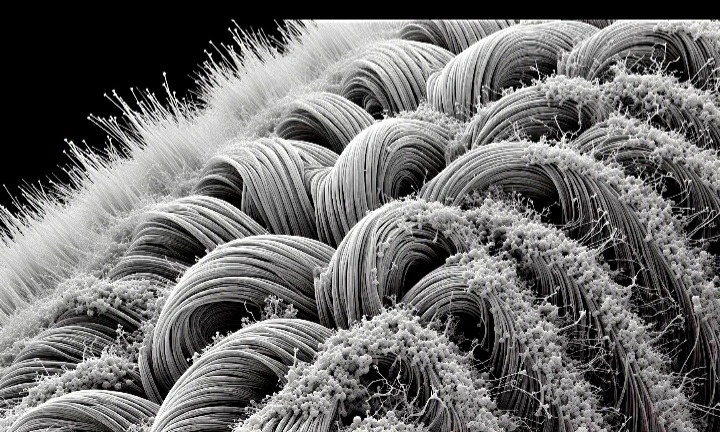
Introduction to Electrospun PAN Nanofiber Yarns
The continuous advancement of tensile polymer science has positioned electrospun Polyacrylonitrile (PAN) nanofiber yarns as a critical material in the development of next-generation structural composites, filtration media, and precursor materials for ultra-high-strength carbon fibers. Electrospinning, a versatile electrohydrodynamic process, enables the fabrication of continuous polymer filaments with diameters ranging from tens to hundreds of nanometers. When these individual nanofibers are collected and dynamically twisted into macroscopic yarns, the resulting hierarchical structure exhibits an exceptionally high surface-area-to-volume ratio and remarkable axial alignment. However, the deployment of these nanofiber yarns in load-bearing applications is fundamentally constrained by their inherent time-dependent mechanical behaviors, specifically viscoelastic creep and stress relaxation. Unlike perfectly elastic materials, which instantaneously return to their original dimensions upon the removal of an applied load, PAN nanofiber yarns exhibit a complex, time-delayed mechanical response dictated by the mobility of their macromolecular chains. Under a constant applied stress, the yarn undergoes progressive, time-dependent deformation known as creep. Conversely, under a constant applied strain, the internal stress required to maintain that deformation gradually decays, a phenomenon known as stress relaxation. Understanding the precise dynamics of these viscoelastic phenomena is paramount for predicting the long-term dimensional stability and structural integrity of PAN-based textiles. The macroscopic viscoelastic response of the yarn is not merely a reflection of the intrinsic polymer properties but is heavily influenced by the microstructural architecture of the yarn itself, including the degree of nanofiber alignment, the inter-fiber frictional forces, and the specific twist multiplier applied during the yarn formation process.
Viscoelastic Terminology and Fundamental Concepts
To rigorously analyze the time-dependent mechanical degradation of electrospun PAN nanofiber yarns, it is necessary to establish a precise lexicon of rheological and polymer physics terminology. The following definitions elucidate the foundational concepts utilized in the characterization of these complex viscoelastic dynamics.
- Viscoelasticity
- The property of materials that exhibit both viscous and elastic characteristics when undergoing deformation. In PAN nanofibers, this manifests as a time-dependent strain response under constant stress, driven by the delayed conformational changes of the polymer chains.
- Creep
- The progressive, time-dependent inelastic deformation of a material subjected to a constant mechanical stress. In nanofiber yarns, primary creep is characterized by a rapidly decreasing strain rate, followed by a steady-state secondary creep, and ultimately tertiary creep leading to rupture.
- Stress Relaxation
- The gradual, time-dependent decrease in internal mechanical stress within a material that is held at a constant macroscopic strain. This occurs as the polymer chains disentangle and slide past one another, dissipating stored elastic strain energy as heat.
- Electrospinning
- An electrohydrodynamic manufacturing technique that utilizes a high-voltage electric field to draw a viscoelastic polymer solution or melt into continuous, ultra-fine nanofibers, which are subsequently twisted into macroscopic yarn assemblies.
- Polyacrylonitrile (PAN)
- A synthetic, semi-crystalline organic polymer resin, characterized by its linear formula (C3H3N)n. It serves as the predominant precursor for high-performance carbon fibers due to its high carbon yield and ability to form highly oriented molecular structures during thermal stabilization.
- Glass Transition Temperature (Tg)
- The critical temperature range wherein an amorphous polymer transitions from a hard, glassy, and brittle state into a viscous, rubbery state. The viscoelastic behavior of PAN is highly sensitive to ambient temperatures approaching its Tg, as thermal energy dramatically increases macromolecular chain mobility.
- Inter-fiber Friction
- The tribological resistance to sliding between adjacent nanofibers within the twisted yarn bundle. This frictional interaction is a primary mechanism for load transfer and significantly retards the macroscopic creep rate of the yarn assembly.
Mathematical Modeling of Viscoelastic Dynamics
The quantification of viscoelastic dynamics in PAN nanofiber yarns requires the application of advanced phenomenological models that combine linear elastic springs and viscous dashpots to simulate the complex behavior of the polymer matrix. The Burgers model is extensively utilized to characterize the creep compliance of the yarns. This four-element model consists of a Maxwell model (a spring and dashpot in series) connected in series with a Kelvin-Voigt model (a spring and dashpot in parallel). The total time-dependent strain under a constant stress is mathematically expressed as \epsilon(t) = \sigma_0 / E_M + \sigma_0 / E_K [1 - \exp(-t / \tau_K)] + \sigma_0 t / \eta_M. In this formulation, \sigma_0 represents the constant applied stress. The term \sigma_0 / E_M denotes the instantaneous elastic deformation governed by the Maxwell spring modulus E_M, corresponding to the immediate stretching of the carbon-carbon backbone bonds within the crystalline domains. The Kelvin-Voigt component, governed by the retardation time \tau_K (where \tau_K = \eta_K / E_K), models the delayed elastic response, representing the uncoiling and alignment of the amorphous polymer chains. Finally, the term \sigma_0 t / \eta_M describes the permanent, non-recoverable viscous flow dictated by the Maxwell dashpot viscosity \eta_M, representing the irreversible slippage of polymer chains past one another.
Conversely, the stress relaxation behavior is most accurately captured using the generalized Maxwell-Weichert model, which consists of multiple Maxwell elements in parallel with a single equilibrium spring. The time-dependent stress decay under a constant strain \epsilon_0 is defined by the equation \sigma(t) = \epsilon_0 (E_{\infty} + \sum_{i=1}^{n} E_i \exp(-t / \tau_i)). Here, E_{\infty} is the equilibrium modulus, and \tau_i represents the discrete relaxation times of the various microstructural phases within the hierarchical yarn. By fitting empirical data to these mathematical models, researchers can isolate the specific contributions of the crystalline and amorphous domains to the overall viscoelastic degradation of the material.
Microstructural Mechanisms of Creep and Relaxation
The microstructural mechanisms governing creep and stress relaxation in electrospun PAN nanofiber yarns operate simultaneously across multiple dimensional scales. At the macromolecular level, the application of a tensile load induces a thermodynamic imbalance. The highly polar nitrile groups along the PAN backbone strongly interact via dipole-dipole forces, creating pseudo-crosslinks that resist initial deformation. However, under continuous stress, these secondary bonds gradually yield, allowing the amorphous chain segments to uncoil and align parallel to the axis of applied tension. This molecular reorganization manifests macroscopically as primary creep. As the chains reach their maximum extension, the deformation transitions into secondary creep, dominated by the irreversible sliding of entire macromolecular chains past one another.
At the mesoscopic level, the hierarchical architecture of the twisted yarn introduces additional complexities. The individual nanofibers within the bundle are not perfectly continuous or perfectly aligned. Under tension, the twisted structure attempts to untwist, generating transverse compressive forces that increase the inter-fiber frictional resistance. This inter-fiber friction acts as a mechanical dampener, significantly reducing the rate of viscous flow compared to a single, isolated nanofiber. The twist multiplier of the yarn is therefore a critical design parameter; higher twist levels increase the transverse confinement and mitigate creep, but excessive twist can introduce localized shear stresses that prematurely rupture the individual filaments, accelerating tertiary creep and catastrophic failure.
Implications for High-Performance Applications
The rigorous characterization of viscoelastic creep and stress relaxation is of paramount importance for the optimization of PAN nanofiber yarns in high-performance industrial applications. In the production of ultra-high-strength carbon fibers, the PAN precursor yarns must undergo a highly controlled thermal stabilization and oxidation process while subjected to continuous axial tension. This applied tension is critical for maintaining the molecular alignment of the polymer chains as they cyclize and crosslink into a rigid ladder polymer structure. If the viscoelastic creep of the yarn is not precisely accounted for, the continuous tension can lead to excessive elongation, resulting in a reduction of the fiber diameter, the introduction of micro-voids, and ultimately, a severe degradation of the final carbon fiber’s tensile modulus.
Furthermore, in the development of advanced filtration media and biomedical scaffolds, the dimensional stability of the electrospun mesh is critical for maintaining the designed pore size and structural porosity over extended operational lifespans. By leveraging the mathematical models and microstructural insights detailed in this analysis, materials scientists can engineer the electrospinning parameters, the polymer molecular weight, and the yarn twist geometry to suppress viscous flow, thereby maximizing the long-term load-bearing efficacy and dimensional fidelity of next-generation PAN nanofiber architectures.