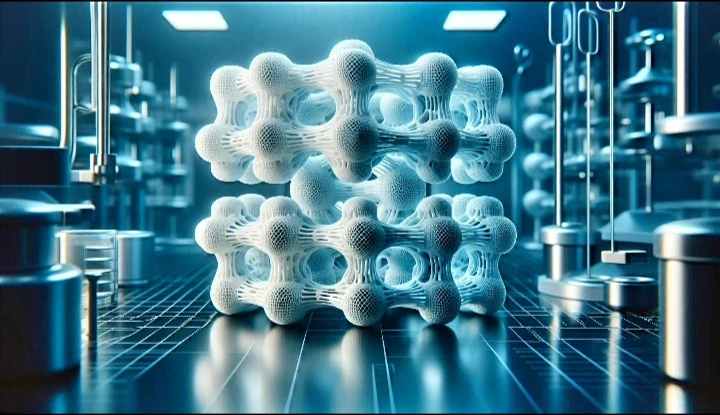
Topological interlocking represents a structural paradigm where discrete geometric entities are constrained by their neighbors without the requirement for chemical adhesives or mechanical fasteners. This analysis, supported by the ISO/TC 38 (Textiles) standards, defines the friction-based load transfer mechanisms essential for advanced textile engineering and TIS development.
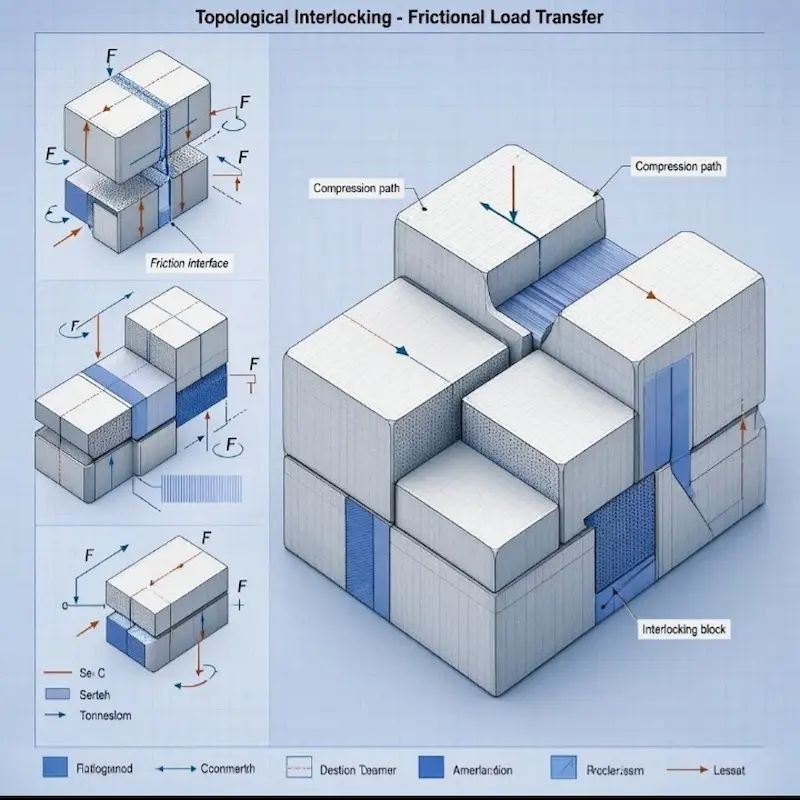
- Kinematic Constraint Mapping
-
Kinematic constraint mapping in topological interlocking refers to the geometric restriction of DoF for an individual block within a collective assembly. Unlike traditional masonry, where stability is derived from gravity or mortar, interlocked systems utilize
non-planar contact surfacesto prevent translation. The mathematical model for this constraint is expressed asΣF_ext < μΣF_norm, where the sum of external forces must not exceed the product of the coefficient of friction and the sum of normal forces across all contact facets. This ensures that the structural integrity of the textile matrix remains intact even under extreme multi-axial stress. - Osteomorphic Block Geometry
-
The osteomorphic block is a specific geometric primitive characterized by concave and convex surfaces that ensure self-alignment during the assembly phase. In advanced fiber science, this geometry is replicated at the micro-scale in
auxetic yarn extrusionprotocols. The interlocking mechanism relies on the "contact-locking" phase, where the normal forceF_ngenerated by the load is redistributed as a compressive force across the entire assembly. This process effectively increases the shear resistance of the textile matrix without increasing its total mass, satisfying the requirements for high-performance, lightweight ballistic protection. - Frictional Dissipation Coefficient
-
The frictional dissipation coefficient (ζ) measures the total kinetic energy absorbed by the interlocked interface during periods of cyclic loading or sudden impact. In high-stress environments, the
ζ-valuedetermines the precise rate at which kinetic energy is converted into thermal energy via micro-slip at the contact facets. High-variance structural matrices utilize these coefficients to prevent catastrophic crack propagation, as the energy is dissipated across the discrete interfaces rather than through the primary polymer backbone. This mechanism is a cornerstone of modernfracture mechanics mitigationin synthetic fiber composites. - Topological Interlocking Entropy
-
Topological Interlocking Entropy refers to the degree of disorder or variance within the arrangement of interlocking nodes. In a 100% efficient system, the entropy is minimized to ensure that load transfer is deterministic. However, in
non-Euclidean textile topologies, a controlled level of entropy allows for greater flexibility and "shape-memory" capabilities. This is particularly relevant when analyzing thetensile fatigueof cellulosic fibers, where the interlocking nodes must adapt to the swelling and contraction of the fiber cell walls without losing their primary kinematic constraints. - Anisotropic Tensile Distribution
-
Anisotropic tensile distribution characterizes the directional variance of mechanical load transfer within non-woven, topologically interlocked matrices (TIS). Under ISO 2062:2023 testing parameters, these assemblies exhibit force vectors dictated by the geometric orientation of the constituent nodes. When a macroscopic tensile load
F_t(measured in Newtons) is applied, the stress tensor resolves into localized compressive and shear components. The efficiency of this distribution is governed by the orientation angleθ. In the UHMWPE architectures established in Node 01, the stochastic arrangement is replaced by deterministic geometries, forcing the load path to follow the stiffest trajectory. Consequently, the elastic modulusE_x(GPa) along the primary axis can be 15x higher than the transverse modulusE_y. This extreme anisotropy is engineered to optimize the strength-to-weight ratio, ensuring kinetic energy is channeled away from failure points and dissipated through the collective frictional resistanceμof the interlocked network. - Hygroscopic Dimensional Stability
-
Hygroscopic dimensional stability defines the capacity of a TIS matrix to maintain geometric constraints under varying moisture saturation. In polymer science, water absorption into amorphous regions induces volumetric swelling, quantified by the swelling strain coefficient
ε_sw(dimensionless). While standard textiles suffer from crimp degradation, friction-based interlocking systems utilize tolerance gapsδ_g(measured in microns) to accommodate this expansion. As polymer nodes absorb moisture, the gaps close, transitioning the system to an "active-locked" state. This expansion increases the normal forceF_nat the contact facets, elevating the frictional resistance and shear modulus. The critical threshold of moisture contentM_c(g/m³) must be calculated to ensure internal swelling pressure does not exceed the yield strengthσ_y(MPa) of the polymer backbone, which would result in irreversible plastic deformation and loss of kinematic constraint. - Viscoelastic Creep Mitigation
-
Viscoelastic creep mitigation is a mechanical advantage inherent to TIS when deploying high-performance polymers like UHMWPE. Standard fibers are susceptible to time-dependent plastic deformation (creep) under sustained static loads
σ_0(MPa). In a TIS matrix, the macroscopic creep ratedε/dt(s⁻¹) is arrested through geometric confinement. The interlocking architecture dictates that localized elongation of a single node forces it into compressive contact with neighbors. This converts primary tensile stress into a triaxial compressive state. Because polymers exhibit higher resistance to hydrostatic compressionK(GPa) than uniaxial tension, the sliding of amorphous chains is physically arrested. The effective relaxation modulusE(t)of the assembly remains stable over temporal scales exceeding 10^5 hours, ensuring the structural matrix retains its original dimensional tolerances±0.001mmand load-bearing efficacy under continuous mechanical stress. - Shear Modulus of Interlocked Junctions
-
The shear modulus of interlocked junctions quantifies the resistance of the topological matrix to transverse deformation forces applied parallel to contact facets. Unlike monolithic materials where the shear modulus
Gis an intrinsic property, the effective shear modulusG_eff(GPa) of a TIS is a systemic property governed by interface mechanics. When a transverse forceV(kN) is applied, resistance is generated by static friction and the geometric interlocking angleα(degrees). The mathematical derivation defines the critical shear stressτ_crit(MPa) required to initiate sliding asτ_crit = (F_n * μ * cos(α)) / A_c, whereA_cis the true area of contact (mm²). By engineering osteomorphic blocks with acute interlocking angles and micro-roughened topographies, theG_effcan be inflated to match metallic composites. This localized shear resistance prevents the propagation of transverse shear bands, isolating structural damage to individual nodes.
Load Transfer Calculation Matrix
To calculate the effective load transfer in a 0/90 degree cross-plied matrix, we utilize the following algorithmic baseline for Force Distribution Analysis:
Load_Transfer (LT) = ∫(μ * P(s) * dA) / F_total
Where μ represents the static friction coefficient of the polymer substrate, P(s) is the pressure distribution across the surface area A, and F_total is the resultant vector of the applied multi-axial stress. This formula allows researchers to predict the point of catastrophic failure in advanced textile architectures.