Fundamental Morphological Characteristics of UHMWPE
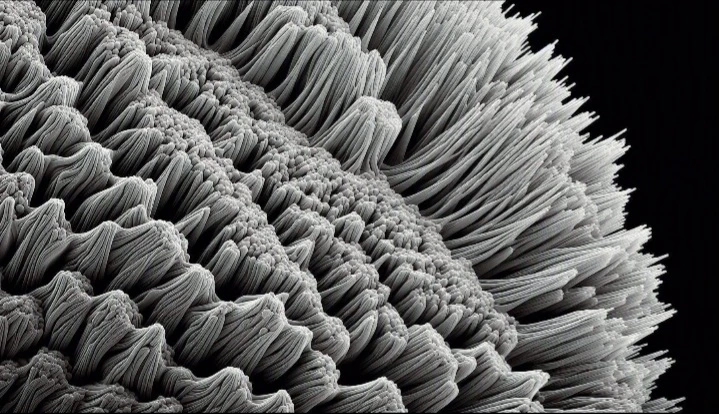
The morphological architecture of Ultra-High Molecular Weight Polyethylene (UHMWPE) is dictated by molecular weights ranging from 3.0 × 10^6 to 7.5 × 10^6 Daltons. This extreme chain length fundamentally alters the thermodynamic and mechanical properties of the polymer, shifting its behavior from a standard thermoplastic to a high-performance engineering material. The polymer matrix consists of highly ordered crystalline domains interspersed with amorphous regions. In the nascent, unoriented state, these long polyethylene chains form folded-chain lamellae. The sheer length of these chains results in a high degree of entanglement within the amorphous regions. Entanglement density scales exponentially with molecular weight. These entanglements act as physical cross-links. They transfer stress between the crystalline domains, providing the material with exceptional impact strength and abrasion resistance.
Morphological analysis of these structures under high-stress environments requires precise quantification of how entangled networks respond to external kinetic and thermal energy inputs. The relationship between molecular weight and chain entanglement is the primary determinant of the mechanical profile. High entanglement density severely restricts the mobility of polymer chains in the melt state. This results in a melt viscosity that is orders of magnitude higher than that of conventional polyolefins. Consequently, UHMWPE cannot be processed using standard melt-extrusion or injection-molding techniques. Specialized processing protocols, such as gel-spinning and solid-state ram extrusion, are mathematically required to bypass these thermodynamic barriers.
Molecular Weight and Chain Entanglement Dynamics
When subjected to high-stress environments, the entanglement network serves a dual purpose. First, it prevents the macroscopic yielding and ductile failure typically observed in lower molecular weight polymers. Tensile load distribution occurs across a vast network of primary carbon-carbon covalent bonds rather than relying solely on weaker intermolecular Van der Waals forces. Second, entanglements limit the degree to which crystalline lamellae can slide past one another. This enhances the material’s resistance to creep under sustained static loads. However, this same entanglement network presents significant thermodynamic challenges during the orientation process, where the objective is to align polymer chains parallel to the fiber axis to maximize tensile strength.
Crystalline vs. Amorphous Domain Interactions
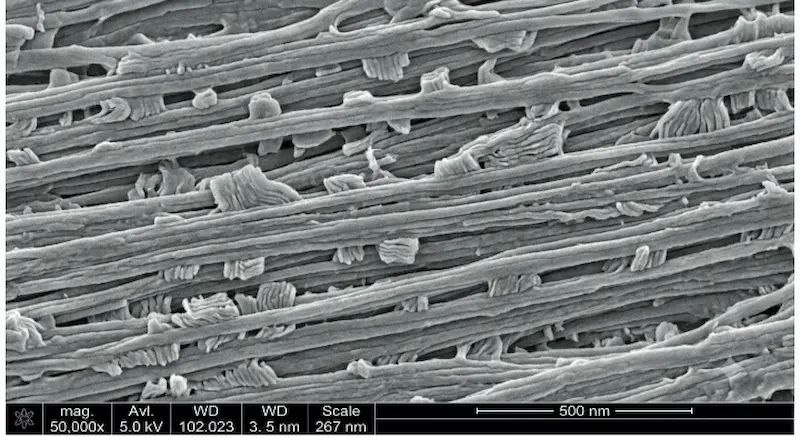
Interaction between crystalline and amorphous domains is highly dependent on the processing history of the material. In highly oriented UHMWPE fibers, the morphology transitions from a folded-chain lamellar structure to an extended-chain fibrillar structure. Crystalline domains become highly aligned along the fiber axis. Amorphous regions are stretched and constrained between the crystals. Tie molecules, defined as polymer chains traversing multiple crystalline and amorphous regions, execute critical load transfer. Under high stress, tie molecules are pulled taut. They transmit applied force directly to the crystalline backbone. The efficiency of this load transfer mechanism allows advanced UHMWPE fibers to achieve tensile strengths exceeding 3.5 GPa.
The precise quantification of these interactions is governed by strict international testing standards. Engineers must adhere to protocols such as those outlined by the American Society for Testing and Materials (ASTM) to ensure the reproducibility of tensile data across varying morphological states.
Synthesis and Advanced Extrusion Protocols
Synthesis of UHMWPE utilizes Ziegler-Natta or metallocene-catalyzed coordination polymerization of ethylene gas. The choice of catalyst and precise control of polymerization conditions (temperature, pressure, monomer concentration) dictate the final molecular weight distribution and the degree of short-chain branching. High-performance fiber applications require a highly linear polymer with minimal short-chain branching to maximize crystallinity and facilitate the drawing process. Once synthesized, the nascent UHMWPE powder must be converted into a usable fiber, requiring the circumvention of the material’s intractable melt viscosity.
Gel-Spinning and Solid-State Extrusion Dynamics
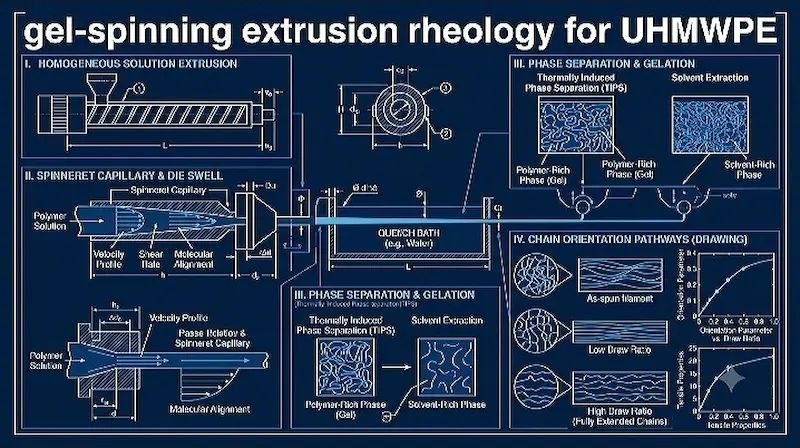
Gel-spinning represents the premier processing technique for producing high-strength, high-modulus UHMWPE fibers. This process circumvents high melt viscosity by dissolving the polymer in a suitable aliphatic solvent. Dissolution disentangles the polymer chains, allowing them to be drawn to extraordinary lengths. Morphological evolution during gel-spinning is a multi-stage process requiring precise thermodynamic and rheological control. The dissolution phase must achieve a homogeneous solution without inducing thermal degradation of the ultra-long chains. The extrusion phase must carefully manage shear forces within the spinneret to pre-align the molecules. The drawing phase must be executed at specific temperatures to maximize chain extension while preventing premature crystallization.
The Step-by-Step Gel-Spinning Methodology
To fully map the morphological transformation, the specific sequence of operations utilized in industrial gel-spinning protocols must be analyzed. The standard methodology for producing extended-chain UHMWPE fibers dictates the following sequence:
- Dissolution: Nascent UHMWPE powder is dissolved in a solvent (decalin or paraffin oil) at elevated temperatures (130°C to 150°C) to form a dilute solution (2% to 10% polymer concentration by weight). This drastically reduces entanglement density.
- Extrusion: The hot polymer solution is extruded through a multi-hole spinneret into a cooling medium. Shear forces within the spinneret capillaries induce preliminary orientation of polymer chains along the flow direction.
- Gelation: As the extruded solution cools, solvent quality decreases. This leads to phase separation and crystallization of the UHMWPE into a continuous gel network consisting of highly swollen, loosely cross-linked folded-chain crystals.
- Solvent Extraction: Solvent is removed from the gel fiber via evaporation (volatile solvents) or extraction with a secondary, more volatile solvent (non-volatile solvents).
- Ultra-Drawing: The dried, solid-state fiber is subjected to a multi-stage drawing process at elevated temperatures (120°C to 150°C). Folded-chain crystals are mechanically unfolded. Polymer chains are highly aligned parallel to the fiber axis, resulting in the final extended-chain morphology.
The ultra-drawing phase determines the final mechanical properties of the fiber. The draw ratio (ratio of final fiber length to initial gel fiber length) can exceed 50:1. As the draw ratio increases, the degree of crystallinity and the crystalline orientation factor approach theoretical maximums. Drawing must be performed below the equilibrium melting temperature of the polymer to maintain the structural integrity of the crystalline domains while allowing sufficient mobility in the amorphous regions for chain sliding.
Tensile Behavior Under Extreme Load-Bearing Conditions
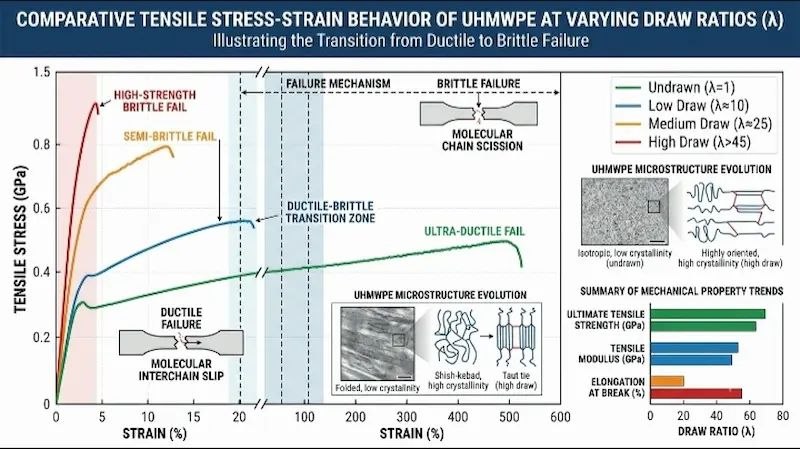
Deployment of UHMWPE fibers in high-stress environments requires rigorous analysis of tensile behavior under varying strain rates. The mechanical response of UHMWPE is highly anisotropic. Properties vary dramatically depending on the direction of the applied load relative to the fiber axis. Along the longitudinal axis, the extended-chain morphology provides exceptional tensile strength and stiffness. In the transverse direction, the material relies on weaker intermolecular forces, increasing susceptibility to shear and compressive failure.
Creep Resistance and Strain Rate Sensitivity
A primary limitation of UHMWPE in sustained load-bearing applications is susceptibility to creep. Creep is defined as the time-dependent plastic deformation of a material under a constant static load. The glass transition temperature (Tg) of UHMWPE is approximately -120°C. Therefore, amorphous regions are in a highly mobile, rubbery state at room temperature. When a sustained load is applied, polymer chains in the amorphous regions slowly slide past one another, leading to macroscopic elongation. Creep behavior is highly non-linear and depends on applied stress, temperature, and specific morphological characteristics.
Advanced morphological engineering techniques, including radiation-induced cross-linking and the incorporation of inorganic nanoparticles, are employed to restrict chain mobility and enhance creep resistance. UHMWPE exhibits significant strain rate sensitivity. Under high-velocity impact conditions, the material behaves in a brittle manner, dissipating kinetic energy through rapid propagation of stress waves along the crystalline backbone. Under slow tensile loading, the material exhibits ductile behavior, allowing for significant plastic deformation prior to failure.
| Draw Ratio (λ) | Morphological State | Yield Strength (GPa) | Young’s Modulus (GPa) | Elongation at Break (%) |
|---|---|---|---|---|
| 1:1 (Undrawn) | Isotropic / Folded-Chain | 0.02 | 1.2 | >300 |
| 10:1 | Partially Oriented | 0.45 | 25.0 | 12.5 |
| 30:1 | Highly Oriented | 1.20 | 75.0 | 4.8 |
| 50:1 | Extended-Chain Fibrillar | 2.15 | 115.0 | 3.2 |
The data matrix demonstrates that ultimate tensile strength and Young’s modulus scale linearly with the draw ratio up to a specific threshold. Beyond this threshold, gains plateau due to physical limitations of chain unfolding and the onset of chain scission. The reduction in elongation at break highlights the transition from a highly ductile material to a rigid, load-bearing structural element.
Thermal and Chemical Resistance Profiles
UHMWPE is highly valued for exceptional chemical inertness and thermodynamic stability in aggressive media. The purely aliphatic hydrocarbon backbone contains no polar functional groups. This renders the polymer highly resistant to hydrolysis, esterification, and common chemical degradation pathways. Thermodynamic stability is a direct function of high crystallinity and dense packing of molecular chains. Crystalline domains act as impermeable barriers to solvent molecules and corrosive ions. High entanglement density restricts the diffusion of penetrant molecules into the amorphous matrix. UHMWPE exhibits near-zero water absorption and remains unaffected by concentrated acids and alkalis at room temperature.
Oxidative Degradation Pathways and Mitigation
The thermal profile of UHMWPE presents specific engineering challenges. The melting point ranges from 135°C to 145°C. At temperatures exceeding 100°C, mechanical properties degrade rapidly as amorphous regions gain excessive mobility and crystalline domains undergo partial melting. Furthermore, UHMWPE is susceptible to oxidative degradation when exposed to ionizing radiation or prolonged ultraviolet (UV) radiation. The degradation mechanism involves the abstraction of a hydrogen atom from the polymer backbone, creating a free radical. In the presence of oxygen, this reacts to form a peroxy radical, initiating a cascade of chain scission reactions that deteriorate molecular weight.
To mitigate oxidative pathways and enhance long-term stability, advanced engineering protocols are utilized. Antioxidant doping incorporates hindered phenols during resin synthesis to scavenge free radicals. Vitamin E blending utilizes Alpha-tocopherol as a biocompatible free-radical scavenger in biomedical grades. Electron beam cross-linking subjects the polymer to controlled radiation in an inert atmosphere, inducing covalent cross-links between adjacent chains. Thermal annealing provides post-irradiation thermal treatment to increase chain mobility, allowing trapped free radicals to recombine and terminate.
| Chemical Reagent / Environment | Concentration | Exposure Temp (°C) | Retention of Tensile Strength (%) |
|---|---|---|---|
| Sulfuric Acid (H2SO4) | 98% | 25 | 99.2 |
| Sodium Hydroxide (NaOH) | 50% | 25 | 99.8 |
| Toluene (Organic Solvent) | 100% | 25 | 97.5 |
| Toluene (Organic Solvent) | 100% | 80 | 82.4 (Swelling Observed) |
Integration of UHMWPE in Advanced Textile Matrices
Transitioning UHMWPE from a raw fiber into a functional, load-bearing textile matrix requires sophisticated weaving, knitting, and braiding technologies. The extremely low coefficient of friction presents a significant challenge in textile engineering. While low friction is advantageous for abrasion resistance, it makes maintaining structural stability in a woven fabric exceedingly difficult. Yarns tend to slip past one another under localized stress. Surface modification techniques, such as atmospheric plasma treatment, are utilized to introduce polar oxygen-containing groups onto the chemically inert fiber surface. This microscopic roughening dramatically increases inter-yarn friction, allowing for the creation of stable, topologically interlocked knitted structures.
Ballistic and Cut-Resistant Topologies
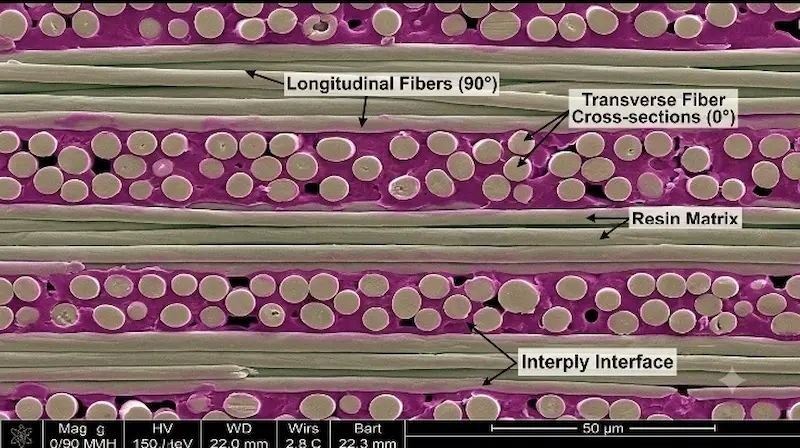
In ballistic protection, traditional woven topologies are sub-optimal for UHMWPE. Crimp introduced during weaving creates localized stress concentrations. This prevents extended-chain molecules from instantaneously transmitting kinetic energy along their longitudinal axis. To maximize ballistic efficacy, engineers developed the cross-plied unidirectional (UD) composite matrix. In a UD composite, UHMWPE fibers are laid flat and parallel, eliminating crimp. These parallel fiber webs are impregnated with a flexible elastomeric resin matrix. Multiple layers are stacked, with each subsequent layer oriented at a 90-degree angle to the previous layer (0°/90°/0°/90° configuration). This cross-plied structure is consolidated under high pressure and temperature.
Upon ballistic impact, the absence of crimp allows the stress wave to propagate through the crystalline domains at extreme velocities, rapidly dissipating energy over a massive surface area. The computational modeling of these stress wave propagations is heavily documented within the digital libraries of the Institute of Electrical and Electronics Engineers (IEEE)
Future Trajectories in Polymer Morphologies
The future of advanced tensile polymer science lies in the manipulation of morphology at the nanometer scale. While the current generation of gel-spun fibers approaches the theoretical limits of macroscopic chain alignment, significant potential remains for enhancing transverse properties and thermal stability through the integration of nanoscale reinforcements. Current research focuses on the co-extrusion of UHMWPE with carbon nanotubes (CNTs) and graphene oxide nanosheets. Dispersing these high-modulus nanomaterials into the dilute polymer solution prior to gel-spinning creates a hierarchical composite morphology.
Nanomaterials act as nucleating agents during the gelation phase, promoting the growth of highly ordered crystalline lamellae directly onto the carbon lattice. The high thermal conductivity of graphene and CNTs provides a pathway for rapid heat dissipation within the fiber. This mechanism potentially overcomes the low melting point limitations of standard UHMWPE, opening new frontiers in high-temperature aerospace and industrial applications. As the understanding of molecular entanglement, solvent extraction thermodynamics, and solid-state drawing rheology is refined, the morphological boundaries of Ultra-High Molecular Weight Polyethylene will continue to expand.