Introduction to TPMS Architectures in Fibrous Networks
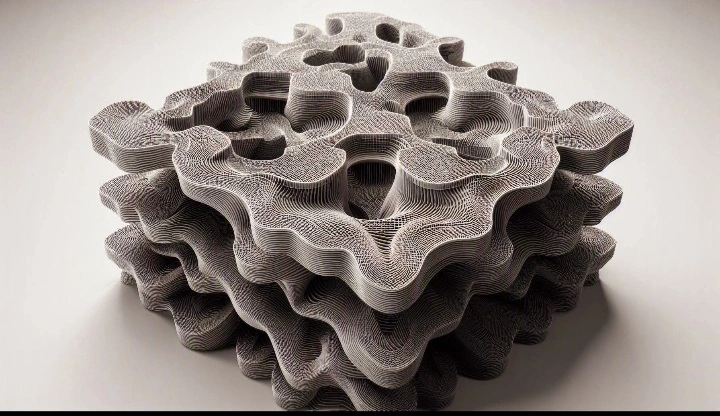
The conceptualization of Triply Periodic Minimal Surfaces (TPMS) has historically been confined to the realms of differential geometry, crystallography, and the study of lipid bilayers in biological systems. A minimal surface is defined mathematically as a surface that locally minimizes its area for a given boundary, possessing a mean curvature of zero at every point. When these surfaces exhibit periodicity in three independent spatial directions, they form TPMS architectures. The translation of these continuous mathematical surfaces into discrete, load-bearing mechanical metamaterials represents a profound advancement in structural engineering. Traditionally, TPMS structures have been fabricated as solid monolithic matrices using additive manufacturing techniques. However, a novel paradigm has emerged in textile engineering: the physical realization of TPMS architectures through the topological interlocking of continuous, highly oriented polymeric yarns. By guiding helical yarns along the principal curvature lines of a theoretical TPMS, engineers can create a highly porous, fibrous metamaterial that derives its structural integrity entirely from kinematic confinement and yarn entanglement, rather than chemical adhesion or rigid nodal bonding. This architectural strategy yields a composite structure that exhibits extraordinary non-linear mechanical properties, characterized by extreme compliance under low-stress regimes and a dramatic, reversible stiffening under high-stress or impact loading. The present discourse provides a comprehensive analysis of the non-linear mechanics governing helical yarn entanglement within TPMS architectures, bridging the gap between differential geometry and macroscopic structural failure.
Mathematical Definition of Triply Periodic Minimal Surfaces
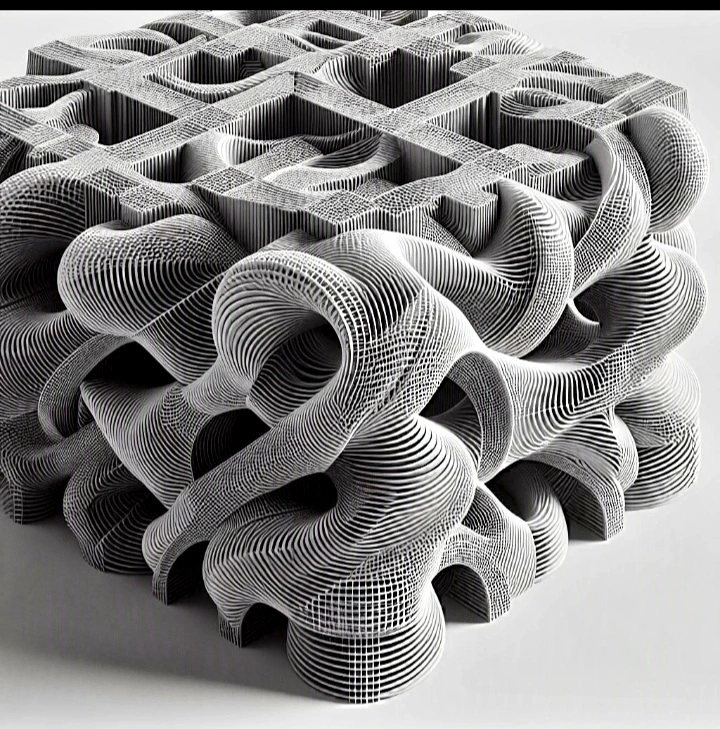
To rigorously analyze the mechanical behavior of a fibrous TPMS metamaterial, one must first establish the mathematical framework that dictates its spatial geometry. Exact parametric equations for TPMS geometries are often highly complex, involving elliptic integrals that are computationally expensive to evaluate. Consequently, researchers frequently rely on nodal approximations based on Fourier series expansions to define the implicit surfaces. These level-set equations provide a highly accurate and computationally efficient method for generating the spatial coordinates of the TPMS boundaries.
The Gyroid and Schwarz Geometries
Among the infinite family of TPMS architectures, the Gyroid, the Schwarz Primitive (P), and the Schwarz Diamond (D) surfaces are the most extensively studied for structural applications due to their high symmetry and isotropic macroscopic properties. The Gyroid surface, discovered by Alan Schoen in 1970, is particularly notable for its lack of straight lines and planar symmetries, making it highly resistant to catastrophic shear failure. The nodal approximation for the Gyroid surface is defined by the equation: sin(x)cos(y) + sin(y)cos(z) + sin(z)cos(x) = 0. The Schwarz P surface, which resembles a network of interconnected plumbing tubes arranged on a simple cubic lattice, is defined by: cos(x) + cos(y) + cos(z) = 0. The Schwarz D surface, based on the diamond lattice structure, is defined by: sin(x)sin(y)sin(z) + sin(x)cos(y)cos(z) + cos(x)sin(y)cos(z) + cos(x)cos(y)sin(z) = 0. By manipulating the isovalue (the constant on the right side of the equation, typically set to zero for a surface dividing space into two equal volumes), engineers can precisely control the volume fraction and the relative density of the resulting metamaterial.
Translation to Topologically Interlocked Fibrous Networks
The transition from a continuous implicit surface to a discrete fibrous network requires a sophisticated mapping algorithm. The continuous TPMS is discretized into a network of principal curvature lines or asymptotic curves. These curves serve as the theoretical trajectories for the continuous polymeric yarns. However, simply laying yarns along these paths does not create a stable structure; the yarns must be topologically interlocked to prevent unraveling and to facilitate load transfer. This is achieved by introducing a helical winding pattern. Instead of following the principal curvature line exactly, the yarn is programmed to follow a helical trajectory that wraps around the theoretical curve. When multiple yarns are introduced along intersecting curvature lines, their helical trajectories overlap and entangle at the nodal junctions of the TPMS lattice. This helical entanglement creates a highly complex, three-dimensional topological interlock. The yarns cannot pass through one another; they are kinematically confined by their mutual physical volume. The degree of this confinement, and consequently the macroscopic stiffness of the metamaterial, is dictated by the pitch of the helix, the diameter of the yarn, and the initial packing fraction of the TPMS lattice.
Kinematics of Helical Yarn Entanglement
The mechanical response of a fibrous TPMS metamaterial is fundamentally governed by the kinematic behavior of the individual helical yarns at the entanglement nodes. Unlike a rigid truss structure, where deformation is primarily axial, the deformation of a topologically interlocked fibrous network is highly non-affine and involves complex, multi-axial stress states.
Helical Trajectories and Nodal Interlocking
The kinematic state of a helical yarn within a TPMS node is defined by a set of generalized coordinates that describe the position and orientation of the filament centerline in three-dimensional space. The primary degrees of freedom include the translational displacement of the yarn segment, the rotational articulation of the helical loops, and the sliding of the filament through the interlocking junction. As an external macroscopic strain is applied to the TPMS lattice, the individual unit cells undergo geometric reorganization. The helical yarns initially rotate and translate to align with the principal axis of loading, minimizing their internal bending strain energy in favor of rigid body displacement. This non-affine reorganization is the primary mechanism responsible for the high initial compliance of the metamaterial. As the yarns displace, the distance between adjacent nodes decreases, and the rotational degrees of freedom become increasingly constrained by the physical interference of the neighboring yarns.

Torsional Rigidity and Bending Stresses
The continuous nature of the polymeric yarn dictates that the model must account for the bending curvature and the torsional twist of the filament segments between the contact points. The mathematical formulation of the kinematic state relies on differential geometry, utilizing the Frenet-Serret frame to describe the local curvature and torsion of the spatial curve. The total strain energy of the unit cell is calculated as the integral of the bending, torsional, and axial strain energy densities along the length of the filament. In a helical entanglement, the application of axial tension to the macroscopic lattice induces severe localized bending and torsional stresses at the nodes. The yarn attempts to straighten, but is prevented from doing so by the interlocking neighboring yarns. This geometric frustration forces the yarn to undergo severe transverse compression and cross-sectional flattening, dynamically altering the contact area and the frictional resistance at the node.
Non-Linear Deformation Mechanisms
The transition from a kinematically mobile, compliant state to a rigid, load-bearing state is accompanied by profound changes in the internal mechanics of the TPMS metamaterial. This phase transition is characterized by rapid void reduction, strain-induced densification, and the sudden emergence of system-wide force percolation networks.
Strain-Stiffening and Jamming
In its initial, unloaded state, the fibrous TPMS lattice contains a significant volume of interstitial void space. These voids provide the necessary free volume for the helical yarns to translate and rotate. As the applied load increases, the kinematic reorganization forces the yarns into tighter configurations, systematically collapsing the interstitial voids. This strain-induced densification results in a highly non-linear increase in the volumetric packing fraction. As the packing fraction approaches a critical threshold, the number of inter-fiber contact points rises exponentially. The system transitions from a state of low coordination to a state of high coordination, eventually reaching a jammed state. At this precise moment, the kinematic mobility of the individual yarns is entirely arrested by the mutual confinement of their neighbors. The macroscopic stiffness of the metamaterial increases by several orders of magnitude, and the load is transferred directly into the axial and transverse deformation of the constituent polymer fibers.
Frictional Interactions and Load Transfer
The stability and ultimate load-bearing capacity of the jammed TPMS network are entirely dependent on the frictional interactions at the helical entanglement nodes. Because the structure lacks chemical binders, the transfer of stress from one yarn to another occurs exclusively through contact friction.
Tribological Modeling of Entangled Nodes
The frictional resistance at an entangled node is governed by a complex interplay of surface morphology, transverse compressive stress, and the viscoelastic properties of the polymer. The classical Coulomb friction model is often insufficient to capture the nuances of this interaction, necessitating the use of modified tribological models that account for the large-scale deformation of the yarn cross-section. The Euler-Eytelwein formula, commonly known as the capstan equation, provides a foundational basis for understanding friction in wrapped filaments, but it must be adapted for the three-dimensional, multi-contact geometry of a TPMS node. The modified equation must incorporate the localized radius of curvature of the interlocking yarns and the dynamic, strain-dependent normal forces generated by the geometric frustration of the lattice.
Coulombic Friction and Stick-Slip Dynamics
As the macroscopic lattice is subjected to dynamic loading, the entangled yarns undergo microscopic stick-slip frictional sliding. When the localized shear stress at a contact point exceeds the static frictional resistance, the yarns slip past one another, dissipating stored strain energy as heat. This slip is quickly arrested as the yarns encounter new geometric constraints or as the localized normal force increases due to strain-induced densification. This continuous cycle of sticking and slipping is a primary mechanism for energy dissipation in the metamaterial. The surface morphology of the constituent yarns plays a crucial role in this process. Yarns engineered with nanoscale surface roughness or specific polymeric coatings can exhibit a higher coefficient of friction, leading to a more stable jammed state and a higher ultimate yield strength, as they can sustain greater shear stresses before localized frictional slip initiates global structural failure.
Energy Dissipation Pathways
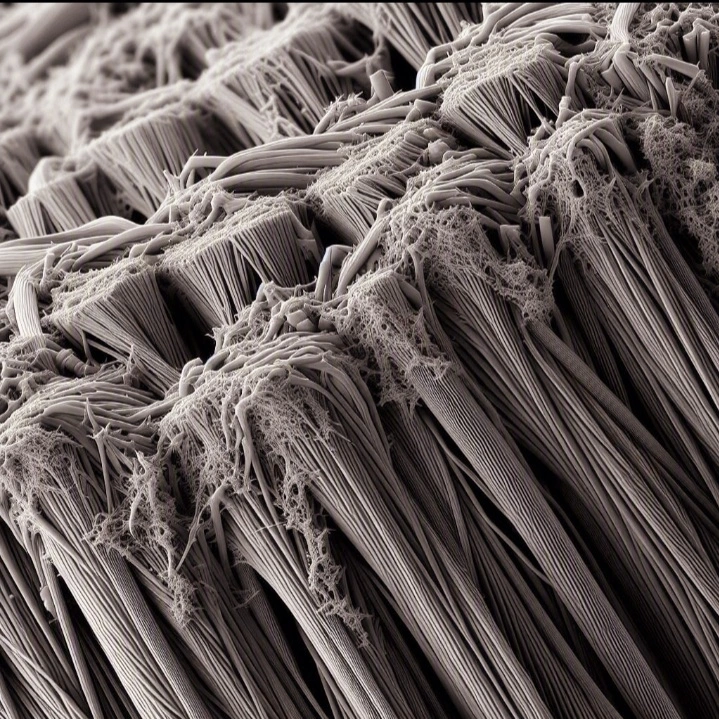
The dissipation of kinetic energy during a high-velocity impact event on a fibrous TPMS metamaterial occurs through a complex sequence of microstructural and macroscopic mechanisms. Understanding these sequential stages is critical for optimizing the lattice design for maximum energy absorption. The primary pathways include:
- Geometric Reorganization: The initial, low-resistance elongation and rotation of the helical yarns, which absorbs energy through the macroscopic deformation of the lattice.
- Frictional Sliding: The massive dissipation of energy as heat through the stick-slip tribological interactions at the thousands of entangled nodes throughout the TPMS structure.
- Viscoelastic Damping: The internal dissipation of energy within the polymer chains of the yarns themselves, driven by the delayed conformational changes of the amorphous domains under dynamic stress.
- Transverse Compression and Yielding: The absorption of energy through the localized plastic deformation, cross-sectional flattening, and eventual fibrillation of the yarns at the points of maximum geometric interference.
Computational Modeling and Empirical Validation
The extreme non-linearity and complex internal architecture of fibrous TPMS metamaterials necessitate a multi-faceted approach to characterization, combining rigorous computational simulations with advanced empirical mechanical testing.
Finite Element Analysis (FEA) of TPMS Lattices
Finite Element Analysis provides a powerful computational framework for simulating the complex mechanical interactions within the entangled network. Due to the computational expense of modeling an entire macroscopic lattice at the microstructural level, FEA is typically applied to representative volume elements (RVEs) or individual TPMS unit cells. The geometric model of the unit cell must accurately capture the precise topology of the helical yarn, including the initial curvature and the contact interfaces between overlapping filament segments.
Constitutive Modeling of Polymer Yarns
The constituent polymeric yarns are modeled using advanced anisotropic, hyperelastic, or viscoplastic constitutive equations that account for the distinct axial and transverse properties of the highly drawn polymer. The contact mechanics at the nodal intersections are modeled using penalty-based or augmented Lagrangian algorithms, incorporating strain-rate and pressure-dependent frictional coefficients. These simulations reveal that the stress distribution within the entangled node is highly heterogeneous. As macroscopic tension is applied, the inner radius of the helical loop experiences severe compressive stresses, while the outer radius is subjected to high tensile stresses due to bending. The following table delineates the geometric parameters utilized in the generation of the computational TPMS unit cells.
| TPMS Architecture | Nodal Equation Approximation | Surface Area to Volume Ratio (mm⁻¹) | Critical Jamming Threshold (Φc) |
|---|---|---|---|
| Gyroid (G) | sin(x)cos(y) + sin(y)cos(z) + sin(z)cos(x) = 0 | 2.45 | 0.42 |
| Schwarz Primitive (P) | cos(x) + cos(y) + cos(z) = 0 | 1.88 | 0.35 |
| Schwarz Diamond (D) | sin(x)sin(y)sin(z) + sin(x)cos(y)cos(z) + … = 0 | 2.72 | 0.48 |

Mechanical Testing Protocols
The empirical characterization of the non-linear mechanics requires specialized testing protocols designed to capture the dynamic phase transitions of the material. Standard uniaxial testing is often insufficient, as the boundary conditions can artificially constrain the lateral deformation of the lattice. Therefore, multi-axial testing, such as biaxial tension or confined compression, is frequently employed. The following procedural framework outlines a standardized protocol for evaluating the mechanical response of a fibrous TPMS metamaterial:
- Specimen Fabrication: Manufacture the fibrous TPMS lattice using automated, multi-axis robotic winding systems to ensure precise helical trajectories and uniform entanglement density.
- Volumetric Characterization: Utilize high-resolution X-ray micro-computed tomography (Micro-CT) to scan the pristine specimen, establishing the baseline void fraction and verifying the topological fidelity of the entanglement nodes.
- Confined Compression Setup: Place the specimen within a rigid, low-friction confinement die to prevent lateral expansion during compression, forcing the lattice to densify internally and accelerating the onset of the jamming transition.
- Dynamic Loading and DIC: Apply a displacement-controlled load using a servo-hydraulic testing machine. Simultaneously, utilize Digital Image Correlation (DIC) to monitor the full-field strain distribution and detect the onset of non-affine geometric reorganization.
- Post-Mortem Microstructural Analysis: Extract the fracture surfaces and subject them to Scanning Electron Microscopy (SEM) to characterize the specific modes of frictional abrasion, localized yielding, and fibrillar failure at the nodes.
The integration of empirical data with computational models allows for the precise quantification of the metamaterial’s performance. The following table illustrates the comparative mechanical properties and energy dissipation metrics derived from these coupled analyses for different TPMS architectures constructed from ultra-high molecular weight polyethylene (UHMWPE) yarns.
| TPMS Topology | Initial Tangent Modulus (MPa) | Post-Jamming Modulus (MPa) | Specific Energy Dissipation (J/g) |
|---|---|---|---|
| Gyroid (G) | 1.2 | 680 | 45.2 |
| Schwarz Primitive (P) | 0.8 | 420 | 28.5 |
| Schwarz Diamond (D) | 1.5 | 850 | 52.7 |
Advanced Applications and Future Trajectories
The ability to precisely engineer the non-linear mechanical response of fibrous TPMS metamaterials opens up a vast array of advanced applications across multiple engineering disciplines. By manipulating the mathematical parameters of the implicit surface, the diameter of the constituent yarns, and the coefficient of friction at the entangled nodes, researchers can program the specific strain threshold at which the material transitions from a compliant fabric to a rigid structural element.
Impact-Resistant Metamaterials
The most immediate and promising application for these metamaterials is in the realm of impact attenuation and ballistic protection. Traditional soft body armor relies on the high tensile strength of woven aramid fibers to catch and decelerate a projectile, often suffering from severe backface deformation that transmits blunt force trauma to the wearer. Fibrous TPMS architectures offer a superior alternative. Upon impact, the localized stress rapidly induces a jamming phase transition directly beneath the projectile. The lattice instantly rigidifies, forming a dense, highly frictional percolation network that distributes the kinetic energy radially outward over a much larger surface area. This dynamic stiffening drastically reduces backface deformation and enhances the overall energy dissipation capacity of the armor system. Furthermore, the inherent porosity of the TPMS structure provides excellent thermal management and breathability, significantly improving the ergonomic comfort of the protective gear.
Biomedical Scaffolding and Tissue Engineering
Beyond high-velocity impact mitigation, the programmable nature of the TPMS architecture is highly attractive for the development of advanced biomedical scaffolds. In tissue engineering, the scaffold must provide a structural framework that mimics the mechanical properties of the native extracellular matrix while possessing a highly interconnected porous network to facilitate cell migration, nutrient transport, and vascularization. The Gyroid surface, in particular, has been shown to closely resemble the trabecular architecture of human cancellous bone. By fabricating fibrous Gyroid scaffolds from biocompatible and biodegradable polymers, such as polycaprolactone (PCL) or polylactic acid (PLA), engineers can create implants that perfectly match the non-linear compressive modulus of the surrounding bone tissue. This mechanical biomimicry prevents stress shielding, a phenomenon where a rigid metallic implant absorbs all the physiological loads, causing the surrounding healthy bone to resorb and weaken. As the fibrous TPMS scaffold gradually degrades in vivo, the newly formed bone tissue infiltrates the porous network, eventually replacing the implant entirely. The continued refinement of the kinematic models detailed in this treatise, coupled with advancements in multi-material additive manufacturing and automated textile fabrication, will be instrumental in realizing the full potential of topologically interlocked fibrous TPMS metamaterials in the next generation of advanced engineering and biomedical systems.