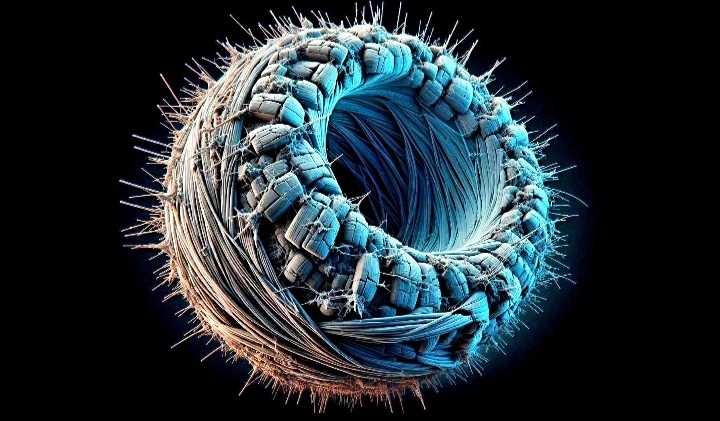
Introduction to Graphene-Oxide Doped Polyethylene Terephthalate
Polyethylene terephthalate, commonly abbreviated as PET, is a highly versatile, semi-crystalline thermoplastic polymer that dominates the global synthetic fiber industry. Its widespread utilization in textile engineering, industrial rigging, and advanced composite matrices is primarily attributed to its exceptional tensile strength, high dimensional stability, and robust chemical resistance. However, despite these favorable macroscopic properties, neat PET monofilaments exhibit a significant vulnerability to localized stress concentrations, rendering them highly notch-sensitive. When subjected to dynamic impact loading or transverse shear forces, the inherent fracture toughness of the pristine polymer is often insufficient to prevent catastrophic crack propagation. To mitigate this critical structural limitation, materials scientists have increasingly turned to the realm of nanotechnology, specifically focusing on the incorporation of two-dimensional carbonaceous nanofillers. Among these, graphene oxide has emerged as a premier reinforcing agent. Graphene oxide is a single-atomic-layer derivative of graphite, heavily functionalized with oxygen-containing moieties such as hydroxyl, epoxide, and carboxyl groups. The strategic doping of the PET matrix with graphene oxide nanosheets fundamentally alters the microstructural architecture of the monofilament. This integration creates a complex, hierarchical nanocomposite that leverages the extraordinary intrinsic mechanical properties of the two-dimensional filler to drastically enhance the energy dissipation capabilities of the bulk polymer. The present treatise provides a comprehensive analysis of the fracture mechanics governing these advanced nanocomposite fibers, elucidating the specific mechanisms by which graphene oxide impedes crack propagation and exponentially increases the macroscopic fracture toughness of the PET monofilament.
The Baseline Properties of PET Monofilaments
To fully appreciate the structural enhancements provided by graphene oxide doping, one must first understand the baseline morphological and mechanical properties of neat PET monofilaments. The fabrication of PET fibers typically involves a melt-spinning process, wherein the molten polymer is extruded through a spinneret, rapidly quenched, and subsequently subjected to a solid-state drawing process. This drawing phase is critical; it mechanically forces the randomly coiled polymer chains to untangle and align parallel to the longitudinal axis of the fiber. This high degree of macromolecular orientation induces stress-induced crystallization, resulting in a highly anisotropic microstructure characterized by alternating crystalline lamellae and amorphous domains. While this axial alignment is responsible for the fiber’s high tensile modulus and ultimate tensile strength, it simultaneously creates planes of weakness parallel to the orientation axis. Because the transverse interactions between the aligned polymer chains rely primarily on relatively weak van der Waals forces and dipole-dipole interactions, the fiber is highly susceptible to longitudinal splitting and fibrillation under transverse or shear loading. When a micro-crack initiates at a surface defect or an internal void, the stress concentrates at the crack tip. In highly drawn neat PET, the energy required to propagate this crack along the orientation axis is remarkably low, leading to rapid, brittle failure with minimal plastic deformation or energy dissipation.
The Role of Graphene-Oxide as a Nanofiller
The introduction of graphene oxide into the PET matrix addresses these inherent microstructural weaknesses through a combination of physical reinforcement and chemical interaction. Unlike pristine graphene, which is highly hydrophobic and tends to agglomerate due to strong pi-pi stacking interactions, graphene oxide is highly amphiphilic. The abundance of oxygen-containing functional groups on its basal planes and edges renders it highly compatible with polar polymer matrices like PET. During the melt-compounding or in-situ polymerization process, these functional groups facilitate the uniform dispersion of the nanosheets throughout the polymer matrix, preventing the formation of large agglomerates that would otherwise act as severe stress concentrators. Furthermore, the two-dimensional geometry of the graphene oxide sheets provides an exceptionally high surface-area-to-volume ratio, maximizing the interfacial contact area between the nanofiller and the polymer matrix. When the doped PET is subjected to the melt-spinning and drawing processes, the graphene oxide sheets also undergo orientation, aligning their basal planes parallel to the fiber axis. This creates a highly ordered, brick-and-mortar-like microstructural architecture. The rigid graphene oxide sheets act as nanoscale reinforcing plates embedded within the semi-crystalline polymer matrix, fundamentally altering the localized stress distribution and providing a formidable physical barrier to the propagation of micro-cracks.
Fracture Mechanics in Nanocomposite Fibers
The study of fracture mechanics in polymeric nanocomposites requires a departure from classical linear elastic fracture mechanics, as the failure of these materials is heavily dictated by localized plastic yielding and complex interfacial phenomena at the nanoscale. Fracture toughness, fundamentally defined as a material’s resistance to the extension of a pre-existing crack, is quantified by the critical stress intensity factor or the critical strain energy release rate. In neat PET monofilaments, the fracture toughness is limited by the rapid transition from localized crazing to catastrophic crack propagation. However, the inclusion of graphene oxide nanosheets introduces a multitude of novel energy dissipation mechanisms that operate synergistically to increase the total work of fracture. These mechanisms are highly dependent on the spatial distribution of the nanosheets, their aspect ratio, and, most importantly, the strength of the interfacial adhesion between the graphene oxide and the surrounding PET matrix. By analyzing these specific toughening mechanisms, we can understand how the nanocomposite architecture effectively delays the onset of critical crack growth and enhances the overall structural resilience of the monofilament.
Mechanisms of Toughening via Nanoparticle Inclusion
The primary mechanisms by which graphene oxide enhances the fracture toughness of PET monofilaments include crack pinning, crack deflection, and the induction of localized plastic deformation. Crack pinning occurs when the propagating crack front encounters a rigid graphene oxide nanosheet that is strongly bonded to the polymer matrix. Because the intrinsic strength of the graphene oxide sheet is vastly superior to that of the PET matrix, the crack cannot easily penetrate the nanofiller. Instead, the crack front is temporarily halted or pinned. To continue propagating, the crack must bow out and circumvent the obstacle, a process that requires a significant increase in the applied strain energy. Crack deflection is a closely related mechanism. When the crack front strikes a graphene oxide sheet at an angle, the rigid barrier forces the crack to deviate from its original planar trajectory. This deflection forces the crack to propagate along a highly tortuous, three-dimensional path. By increasing the total surface area of the fracture plane, the nanocomposite dissipates a substantially larger amount of energy compared to the smooth, planar fracture typical of neat PET. Furthermore, the presence of the nanosheets alters the localized stress field ahead of the crack tip, promoting extensive plastic yielding and shear banding in the surrounding amorphous polymer domains, which serves as an additional, highly effective energy sink.
Interfacial Adhesion and Stress Transfer
The efficacy of the aforementioned toughening mechanisms is entirely contingent upon the quality of the interfacial adhesion between the graphene oxide nanosheets and the PET matrix. If the interfacial bond is weak, the propagating crack will simply bypass the nanosheet by debonding the interface, resulting in minimal energy dissipation and potentially even decreasing the overall fracture toughness by creating interfacial voids. However, the unique surface chemistry of graphene oxide facilitates exceptionally strong interfacial interactions. The hydroxyl and carboxyl groups on the graphene oxide surface can form extensive hydrogen bonding networks with the ester carbonyl groups of the PET backbone. In certain high-temperature processing conditions, it is even possible for transesterification reactions to occur, creating direct covalent linkages between the nanofiller and the polymer matrix. This robust interfacial adhesion ensures highly efficient stress transfer from the compliant polymer matrix to the ultra-stiff graphene oxide sheets. When a crack approaches, the stress is transferred across the interface, loading the nanosheet in tension. The energy required to either rupture the graphene oxide sheet or pull it out of the polymer matrix contributes massively to the macroscopic fracture toughness of the monofilament, transforming a brittle failure mode into a highly ductile, energy-absorbing process.
Crack Propagation Dynamics and Failure Modes
The dynamic progression of structural failure in graphene-oxide doped PET monofilaments is a complex, multi-stage process that differs fundamentally from the failure of pristine polymer fibers. The transition from the initial nucleation of a micro-defect to the ultimate catastrophic rupture of the macroscopic fiber is governed by the continuous interaction between the advancing crack front and the dispersed nanoscale reinforcement. By examining the specific stages of crack propagation—from the initial formation of crazes to the final, tortuous fracture—we can elucidate the precise microstructural phenomena that grant these nanocomposite fibers their superior mechanical resilience.
Initiation and Micro-void Coalescence
In semi-crystalline polymers like PET, the initiation of fracture is typically preceded by a phenomenon known as crazing. A craze is a localized region of highly yielded polymer that is spanned by highly oriented micro-fibrils, separated by interconnected micro-voids. Crazes typically nucleate at sites of stress concentration, such as surface scratches, internal impurities, or the boundaries between amorphous and crystalline domains. In neat PET, these crazes widen rapidly under applied stress; the load-bearing fibrils stretch, thin, and eventually rupture, causing the micro-voids to coalesce into a true macroscopic crack. The introduction of graphene oxide nanosheets fundamentally disrupts this initiation phase. The well-dispersed nanosheets act as physical cross-links within the amorphous domains, restricting the mobility of the polymer chains and significantly increasing the stress threshold required to initiate a craze. Furthermore, when a craze does form, the graphene oxide sheets bridge the gap between the craze boundaries. These nanoscale bridges bear a significant portion of the localized stress, preventing the premature rupture of the polymer fibrils and drastically delaying the coalescence of the micro-voids into a critical crack. This suppression of craze breakdown is a primary factor in the enhanced yield strength and delayed fracture initiation observed in the doped monofilaments.
Tortuous Crack Path and Energy Dissipation
Once a critical crack has formed and begins to propagate through the monofilament, the dynamics of failure are dictated by the tortuosity of the crack path. In a highly drawn neat PET fiber, a crack propagating perpendicular to the fiber axis will often redirect longitudinally, splitting the fiber along the weak inter-fibrillar boundaries in a rapid, low-energy failure. In the graphene-oxide doped PET, the highly aligned nanosheets act as impenetrable barriers to this rapid longitudinal splitting. As the crack front advances, it is continuously deflected, pinned, and forced to bifurcate by the dispersed graphene oxide sheets. This creates a highly complex, jagged fracture surface. The energy dissipated during this tortuous propagation is orders of magnitude higher than in the neat polymer. Additionally, as the crack forces its way past the nanosheets, the strong interfacial adhesion leads to a phenomenon known as frictional pull-out. The graphene oxide sheets are slowly extracted from the polymer matrix, a process that requires the continuous overcoming of interfacial shear friction. The cumulative energy absorbed by the creation of a massive, three-dimensional fracture surface, combined with the frictional dissipation of nanosheet pull-out, culminates in a monofilament that exhibits extraordinary fracture toughness and a remarkable resistance to catastrophic impact failure.
Empirical Evaluation and Microstructural Analysis
To validate the theoretical mechanisms of fracture toughness enhancement, rigorous empirical testing and advanced microstructural characterization are required. The mechanical properties of the monofilaments are typically evaluated using specialized single-fiber tensile testing apparatuses, which measure the ultimate tensile strength, the elastic modulus, and the total work of fracture (the area under the stress-strain curve). To specifically quantify fracture toughness, notched fiber testing is employed, wherein a microscopic flaw of a known geometry is introduced into the fiber prior to tensile loading. The resulting data allows for the calculation of the critical stress intensity factor, providing a direct metric of the material’s resistance to crack propagation.
Tensile Testing and Fractography
The empirical data derived from tensile testing consistently demonstrates that the optimal doping concentration of graphene oxide—typically ranging between 0.1 and 0.5 weight percent—yields the most significant improvements in mechanical performance. Beyond this optimal threshold, the nanosheets tend to agglomerate, creating macroscopic defects that act as stress concentrators and prematurely initiate failure. To understand the physical manifestation of these mechanical improvements, researchers rely heavily on high-resolution Scanning Electron Microscopy (SEM) to perform fractographic analysis on the ruptured monofilaments. The fractographs of neat PET fibers typically reveal a relatively smooth, glassy fracture surface, indicative of a rapid, brittle failure with minimal plastic yielding. In stark contrast, the fracture surfaces of the graphene-oxide doped PET monofilaments are highly irregular and rough. The SEM images reveal extensive localized plastic deformation, massive fibrillar pull-out, and a highly tortuous topography. At higher magnifications, it is often possible to observe the individual graphene oxide nanosheets protruding from the polymer matrix, providing direct visual confirmation of the crack deflection and frictional pull-out mechanisms that are responsible for the exponential increase in the macroscopic fracture toughness.
Comparative Performance Metrics
The integration of graphene oxide into the PET matrix yields a synergistic enhancement of multiple mechanical properties. The following table provides a comprehensive comparative analysis of the mechanical performance and the observed failure mechanisms of neat PET monofilaments versus those doped with an optimized 0.3 weight percent concentration of graphene oxide. The data clearly illustrates the profound impact of the nanoscale reinforcement on the structural integrity and the energy dissipation capabilities of the advanced textile fibers.
| Material Formulation | Mechanical Properties and Failure Analysis | ||
|---|---|---|---|
| Tensile Modulus (GPa) | Fracture Toughness (MPa m^0.5) | Observed Failure Mechanisms | |
| Neat PET Monofilament (Control) | 12.4 | 1.85 |
|
| Graphene-Oxide Doped PET (0.3 wt%) | 16.8 | 4.12 |
|