Introduction to Anisotropic Thermal Dynamics
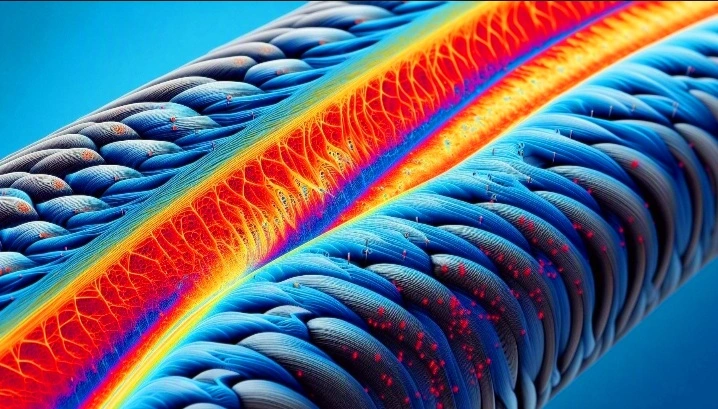
Carbon fiber reinforced polymers are renowned for their exceptional specific strength and stiffness, but their thermal properties are equally critical in high-performance aerospace and automotive applications. The inherent structure of a carbon fiber, characterized by highly aligned graphitic basal planes along the longitudinal axis, results in extreme thermal anisotropy. Thermal conductivity along the fiber axis can be orders of magnitude higher than in the transverse radial direction. When these fibers are woven into a biaxial braided preform and infused with a polymeric matrix, this microscopic anisotropy translates into a complex macroscopic thermal conductivity tensor. Biaxial braided composites, specifically, offer unique advantages in torsional and multi-axial load-bearing scenarios due to their continuous, interlocking tow architecture. However, the thermodynamic behavior of these structures is not static; it is highly dependent on the applied mechanical stress state. Under compressive loading, the internal microstructural geometry of the braid undergoes significant deformation, fundamentally altering the pathways available for heat flux. Understanding this dynamic relationship between compressive strain and anisotropic thermal conductivity is paramount for the design of advanced structural components that must simultaneously manage severe mechanical loads and extreme thermal gradients.
Microstructural Architecture of Biaxial Braids
The microstructural architecture of a biaxial braided composite is defined by the interlacing of two sets of continuous fiber tows, typically oriented at positive and negative braiding angles relative to the longitudinal axis of the component. This interlacing creates a characteristic undulation, or crimp, in the fiber paths. The thermal conductivity of the composite is a function of the intrinsic conductivities of the carbon fibers and the polymer matrix, the fiber volume fraction, the braiding angle, and the interfacial thermal resistance between the fibers and the matrix. Because the polymer matrix typically acts as a thermal insulator compared to the highly conductive carbon fibers, heat flux preferentially travels along the continuous fiber tows. The undulation of the tows introduces localized off-axis fiber orientations, which forces the heat flux to traverse the highly resistive matrix-rich inter-tow regions or rely on fiber-to-fiber contact points. Consequently, the macroscopic thermal conductivity is highly anisotropic, exhibiting maximum values along the principal fiber directions and minimum values in the through-thickness direction.
Compressive Loading and Thermal Flux Alteration
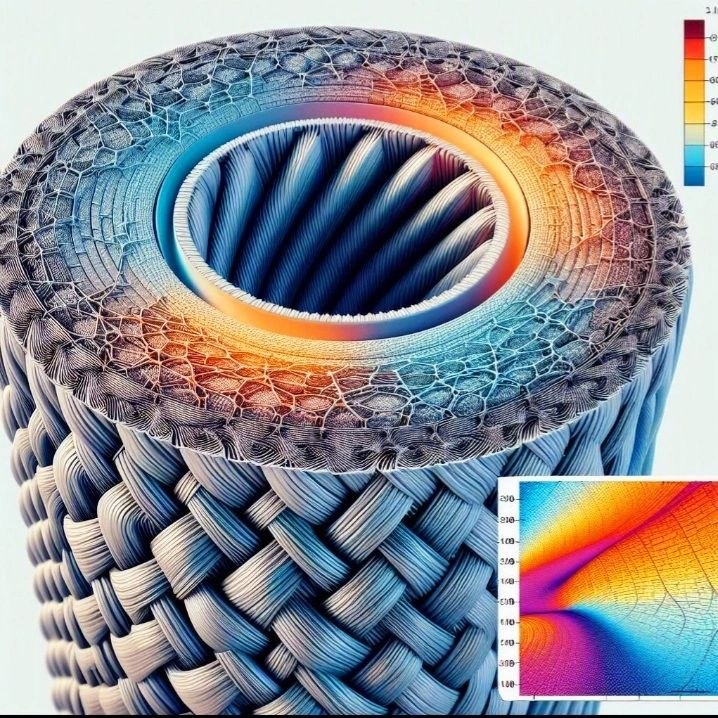
When a biaxial braided composite is subjected to compressive loading, the internal microstructural geometry undergoes a series of complex, non-linear deformations that directly impact its thermal transport properties. Initially, the compressive stress induces a flattening of the undulating fiber tows, reducing the amplitude of the crimp and increasing the localized fiber volume fraction at the interlacing nodes. This geometric compaction enhances the fiber-to-fiber contact area, creating new, highly conductive pathways for phonon transport and temporarily increasing the through-thickness thermal conductivity. However, as the compressive strain increases, the disparity in the Poisson’s ratios of the rigid carbon fibers and the compliant polymer matrix generates severe interfacial shear stresses. These stresses initiate micro-cracking within the matrix and debonding at the fiber-matrix interface. These microstructural defects act as potent phonon scattering sites, introducing significant thermal contact resistance. The propagation of these micro-cracks effectively severs the transverse thermal bridges, leading to a sudden and dramatic reduction in the transverse and through-thickness thermal conductivity. Meanwhile, the axial thermal conductivity may remain relatively stable until catastrophic fiber micro-buckling occurs. This dynamic, strain-dependent alteration of the thermal conductivity tensor necessitates the use of coupled thermo-mechanical models to accurately predict the behavior of these composites in operational environments.

The empirical observation of strain-induced crystallization in aramid fibers reveals a non-linear relationship between cycle frequency and thermal accumulation. As the matrix reaches its saturation point, the energy dissipation shifts from elastic recovery to permanent micro-structural displacement, establishing the critical threshold for thermodynamic failure.
Methodological Framework for Thermal-Mechanical Testing
To accurately quantify the dynamic evolution of anisotropic thermal conductivity under compressive stress, a highly specialized, coupled thermo-mechanical testing methodology is required. Standard steady-state thermal conductivity measurements are insufficient, as they cannot capture the transient microstructural changes induced by active mechanical loading. The following procedural framework outlines the rigorous step-by-step methodology utilized to empirically characterize this complex phenomenon:
- Specimen Fabrication and Preparation: Manufacture the biaxial braided carbon fiber composite utilizing vacuum-assisted resin transfer molding to ensure a consistent fiber volume fraction, followed by precision machining into standard compressive test coupons with highly polished parallel loading faces to minimize thermal contact resistance at the boundaries.
- Sensor Integration and Calibration: Embed ultra-thin, fast-response micro-thermocouples at precise depths within the composite laminate during the curing process, and calibrate a high-resolution infrared thermography camera to monitor the surface temperature distribution and detect localized thermal anomalies.
- Thermo-Mechanical Test Setup: Mount the instrumented specimen within a servo-hydraulic universal testing machine equipped with insulated, temperature-controlled compression platens capable of establishing a precise, steady-state thermal gradient across the specimen thickness.
- Dynamic Compressive Loading Execution: Apply a displacement-controlled compressive load at a quasi-static strain rate while simultaneously maintaining the thermal gradient, ensuring that the mechanical deformation occurs slowly enough to allow for continuous, quasi-steady-state thermal flux measurements.
- Data Acquisition and Tensor Calculation: Continuously record the applied compressive stress, the resulting macroscopic strain, the internal temperature gradients from the embedded thermocouples, and the surface thermography data, subsequently utilizing inverse heat conduction algorithms to calculate the evolving components of the anisotropic thermal conductivity tensor as a function of compressive strain.
Implications for High-Performance Engineering
The rigorous characterization of anisotropic thermal conductivity under compressive loading holds profound implications for the design and optimization of high-performance engineering structures. In the aerospace sector, components such as leading edges, engine nacelles, and re-entry heat shields are routinely subjected to simultaneous aerodynamic compression and extreme thermal fluxes. If the strain-induced degradation of transverse thermal conductivity is not accurately accounted for in the computational models, the localized accumulation of thermal energy can rapidly exceed the glass transition temperature of the polymer matrix, precipitating catastrophic structural failure. By integrating the dynamic thermo-mechanical data derived from the aforementioned testing protocols into advanced finite element simulations, engineers can optimize the braiding angle and the matrix toughness to maintain critical thermal pathways even under severe compressive loads. Ultimately, the mastery of these coupled phenomena enables the development of lighter, more resilient composite architectures capable of surviving the most demanding thermodynamic environments encountered in modern aerospace applications.