Thermodynamic Fundamentals of Polymer Matrices
Phonon Scattering and Heat Flux Mechanisms
The thermal conductivity of polymer matrices is fundamentally governed by phonon transport mechanisms. Unlike metallic structures where free electrons facilitate rapid heat transfer, polymers rely on the propagation of quantized lattice vibrations, or phonons. According to Fourier’s law of heat conduction, the intrinsic thermal conductivity (K-value) is directly proportional to the phonon mean free path. In standard isotropic polymers, the presence of extensive amorphous regions induces severe phonon scattering. This scattering disrupts the vibrational wave propagation, drastically reducing the mean free path and resulting in characteristically low heat flux capacities. The thermodynamic efficiency of a topological interlocking structure is therefore heavily dependent on minimizing these amorphous scattering interfaces to prevent localized thermal accumulation under mechanical stress.
Morphological Constraints on Thermal Transport
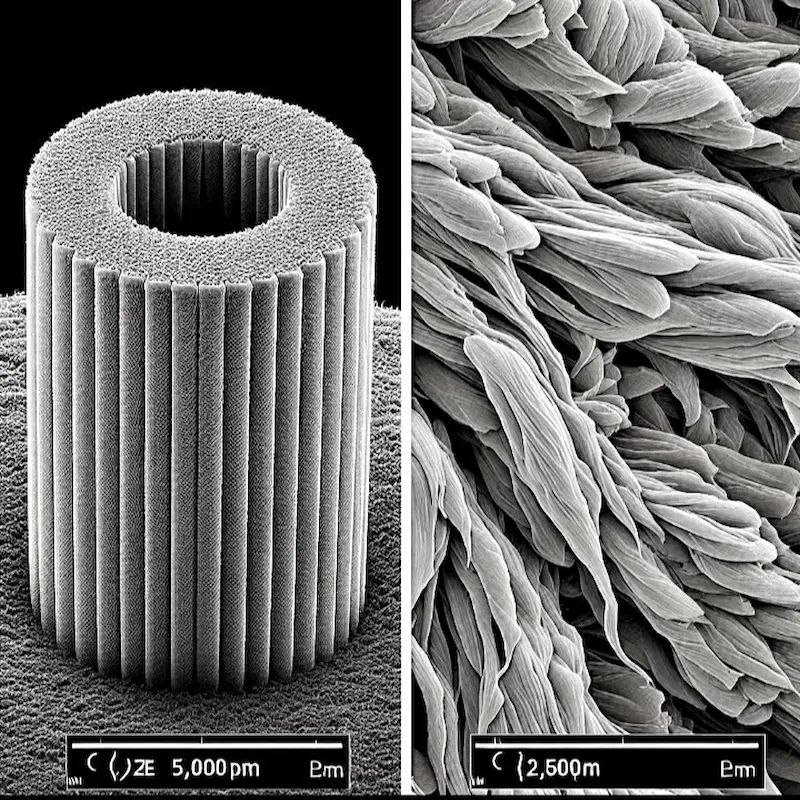
The morphological architecture of a polymer dictates its thermodynamic profile. Highly crystalline, extended-chain synthetic polymers exhibit extreme anisotropic thermal conductivity. The alignment of the carbon-carbon covalent backbone along the longitudinal axis provides an uninterrupted, high-velocity pathway for phonon propagation. Consequently, the longitudinal K-value of oriented synthetic fibers can exceed that of transverse pathways by two orders of magnitude. Natural polymers, conversely, possess complex, hierarchical microstructures with high concentrations of hydrogen bonding and isotropic domain orientations. These morphological constraints inherently limit their maximum thermal conductivity, rendering them highly susceptible to thermodynamic degradation when deployed in high-friction, load-bearing environments.
Empirical Data: Thermal Conductivity Matrix
Methodology for K-Value Derivation
The derivation of precise thermal conductivity coefficients requires rigorous empirical testing under steady-state heat flux conditions. Specimens are evaluated utilizing guarded hot plate methodologies, ensuring that unidirectional heat flow is maintained across the polymer matrix. By subjecting the interlocked nodes to controlled thermal gradients, engineers can isolate the intrinsic K-value of the material from the interfacial thermal resistance generated at the contact facets. This empirical data is critical for calculating the thermodynamic failure thresholds of advanced textile assemblies, allowing for the accurate prediction of heat dissipation rates during cyclic mechanical loading.
Comparative Analysis of Interlocked Topologies
The subsequent data matrix delineates the thermodynamic profiles of synthetic and natural polymers utilized in topological interlocking structures. The integration of specific thermal variables highlights the stark contrast in heat dissipation capacities and thermodynamic degradation thresholds. Understanding these parameters is essential for engineering matrices capable of surviving high-stress, high-friction operational environments without succumbing to localized melting or structural yielding.
| Polymer Classification | Thermal Conductivity (W/m·K) | Heat Flux Capacity | Thermodynamic Degradation Variables | |
|---|---|---|---|---|
| Longitudinal Axis | Transverse Axis | |||
| UHMWPE (Synthetic) | 41.00 | 0.35 | Extreme |
|
| Para-Aramid (Synthetic) | 3.00 | 0.14 | Moderate |
|
| Bombyx Mori Silk (Natural) | 1.20 | 1.20 | Low |
|
| Merino Wool (Natural) | 0.05 | 0.05 | Minimal |
|
Load-Bearing Implications of Thermal Degradation
Heat Dissipation in High-Friction Environments
Topological interlocking structures derive their macroscopic stability entirely from friction-based load transfer mechanisms at the discrete contact facets. Under cyclic mechanical loading, the continuous micro-slip between these geometric nodes generates significant localized thermal energy. If the constituent polymer matrix possesses a low thermal conductivity, this generated heat cannot dissipate into the surrounding environment. The resulting thermal accumulation rapidly elevates the localized temperature at the contact interface. Once this temperature exceeds the glass transition or melting point of the polymer, the geometric nodes undergo plastic deformation, resulting in a catastrophic loss of kinematic constraint and the ultimate failure of the textile assembly.
Thresholds for Thermodynamic Failure
The ultimate load-bearing capacity of an interlocked matrix is inextricably linked to its thermodynamic stability. Synthetic polymers engineered with high longitudinal thermal conductivity effectively channel thermal energy away from the high-friction nodes, acting as intrinsic heat sinks. This rapid heat flux preserves the structural integrity of the assembly under extreme mechanical stress. Conversely, natural polymers, while possessing favorable tensile properties in static environments, act as thermal insulators. Their inability to dissipate friction-induced heat severely limits their application in dynamic, high-stress topological interlocking structures, establishing a strict thermodynamic threshold for material selection in advanced engineering protocols.