Introduction to Alumina-Silicate Ceramic Fibers
In the demanding arenas of aerospace engineering, industrial metallurgy, and advanced power generation, the necessity for materials capable of withstanding extreme thermal gradients while simultaneously bearing significant mechanical loads is absolute. Alumina-silicate ceramic fiber mats have emerged as a critical solution to this dual-requirement challenge. Composed primarily of aluminum oxide and silicon dioxide, these refractory fibers are typically manufactured via a high-velocity melt-spinning or pneumatic blowing process. This manufacturing technique results in a highly porous, non-woven, stochastically entangled matrix. The inherent chemical stability of the alumina-silicate system grants these fibers exceptional resistance to oxidation, thermal shock, and chemical attack at temperatures frequently exceeding 1200 degrees Celsius. However, the true engineering value of these mats lies not just in their raw thermal resistance, but in their complex microstructural architecture. The random, three-dimensional entanglement of the ceramic fibers creates a vast network of interstitial voids, which are responsible for the material’s remarkably low thermal conductivity. Yet, this same high-porosity architecture renders the mats highly susceptible to compressive deformation. When deployed as thermal gaskets, expansion joint seals, or furnace linings, these mats are invariably subjected to significant compressive loads. As the mat compresses, its internal geometry alters, fundamentally changing both its mechanical yield behavior and its thermal insulation efficacy. As noted by Dr. H. V. Konda in his extensive research on refractory textiles, the thermal performance of a ceramic fiber mat is not a static property; it is a dynamic variable inextricably linked to its instantaneous state of compressive strain.
Consequently, a rigorous understanding of the non-linear compressive mechanics and the resulting thermodynamic alterations is paramount for the reliable design of high-temperature insulation systems.
Microstructural Architecture and Porosity
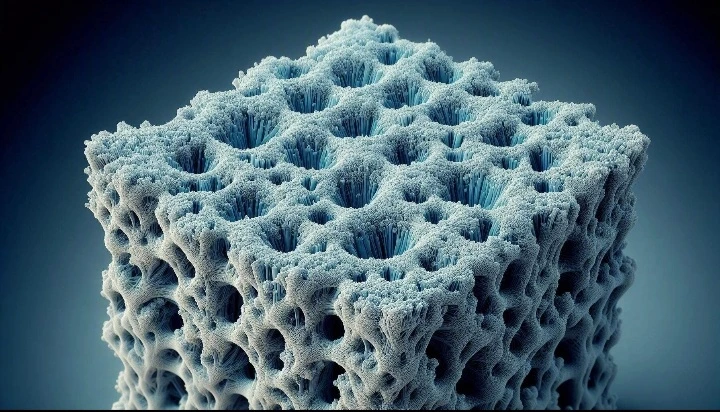
The macroscopic properties of an alumina-silicate fiber mat are dictated by its microstructural architecture. Unlike woven textiles, which possess a highly ordered, deterministic geometry, non-woven ceramic mats are characterized by a stochastic distribution of fiber orientations and lengths. The fibers, typically ranging from two to six micrometers in diameter, are held together primarily by mechanical interlocking and frictional forces at the fiber-to-fiber contact points, rather than by chemical binders. This binderless construction is crucial for high-temperature applications, as organic binders would rapidly volatilize, compromising the structural integrity of the mat and generating undesirable outgassing. The resulting architecture is highly porous, with void fractions often exceeding ninety percent in the uncompressed state. This extreme porosity is the primary mechanism for thermal insulation. The entrapped air or specific atmospheric gas within the interstitial voids acts as an excellent thermal insulator, severely restricting convective heat transfer. Furthermore, the tortuous, random pathways of the solid ceramic fibers minimize the cross-sectional area available for solid-state thermal conduction. However, this high void fraction also means that the mat possesses a very low initial compressive modulus. The structural stability of the mat under load relies entirely on the bending stiffness of the individual ceramic fibers and the stability of the frictional contact points.
The efficacy of a non-woven ceramic fiber mat as a thermal insulator is fundamentally derived from its high void fraction; however, this same microstructural characteristic dictates a highly non-linear, strain-dependent mechanical response under compressive loading.
Mechanisms of Compressive Deformation
When a compressive load is applied to the alumina-silicate mat, the deformation process occurs in three distinct, non-linear phases. The initial phase is characterized by a highly compliant, low-modulus response. During this phase, the macroscopic compression is accommodated primarily by the rigid-body translation and rotation of the individual fibers. The fibers slide past one another, overcoming the initial static friction at the contact points, and reorient themselves to occupy the available free volume within the interstitial voids. This geometric reorganization requires relatively little force, resulting in a large macroscopic strain for a small applied stress. As the compressive strain increases, the mat enters the second phase, often referred to as the pseudo-elastic region, although true linearity is rarely observed in these stochastic networks. In this phase, the free volume is significantly reduced, and the number of fiber-to-fiber contact points increases exponentially. The deformation is no longer accommodated by simple translation; instead, the individual ceramic fibers begin to bend between the numerous contact points. The macroscopic compressive modulus of the mat is now governed by the intrinsic flexural rigidity of the alumina-silicate fibers. Because ceramic fibers are inherently brittle, this bending introduces significant localized tensile stresses on the outer radius of the curved fibers. If the localized stress exceeds the ultimate tensile strength of the ceramic, the fiber will fracture.
Yield Behavior and Fiber Fracture
The transition to the third phase of compressive deformation marks the onset of macroscopic yielding and irreversible structural damage. As the compressive load continues to rise, the density of the mat increases dramatically. The fibers are forced into tight, highly constrained configurations. The localized bending stresses at the contact points become severe, leading to widespread, catastrophic fiber fracture. This microstructural failure is the primary mechanism of compressive yielding in ceramic fiber mats. Unlike ductile metals or polymers, which yield through plastic deformation and dislocation movement, the alumina-silicate fibers yield through brittle comminution. The continuous fibers are broken into shorter, discrete segments. This fragmentation fundamentally alters the load-bearing architecture of the mat. The fractured segments can rearrange more densely, leading to a phenomenon known as strain-hardening or densification. The macroscopic compressive stress-strain curve exhibits a sharp, exponential upward trajectory as the mat approaches its theoretical maximum density. However, this densification comes at a severe cost. The irreversible fracture of the fibers means that upon unloading, the mat will exhibit massive hysteresis and a significant loss of its original thickness, known as permanent set. The structural integrity and the resilience of the mat are permanently compromised.
The compressive yielding of non-woven ceramic fiber mats is not characterized by plastic flow, but rather by the widespread, brittle fracture of the constituent fibers, a highly dissipative process that permanently alters the microstructural architecture and the thermodynamic properties of the material.
Thermal Insulation Efficacy Under Compression
The thermal insulation efficacy of an alumina-silicate fiber mat is quantified by its apparent thermal conductivity. In a porous medium, the apparent thermal conductivity is a complex superposition of three distinct heat transfer mechanisms: solid conduction through the ceramic fibers, gaseous conduction through the interstitial voids, and radiative heat transfer across the pore spaces. The relative contribution of each mechanism is highly dependent on the ambient temperature and, critically, the state of compressive strain.
Solid and Gaseous Conduction Dynamics
In the uncompressed state, gaseous conduction is typically the dominant mode of heat transfer at lower temperatures, as the volume fraction of the solid ceramic is minimal. The solid conduction is restricted by the tortuous pathways and the high thermal contact resistance at the sparse fiber-to-fiber intersections. However, as the mat is subjected to compressive loading, the microstructural architecture changes dramatically, altering the balance of these heat transfer mechanisms. The compressive strain reduces the overall thickness of the mat and collapses the interstitial voids, thereby increasing the bulk density. This densification has opposing effects on the different modes of thermal transport. On one hand, the reduction in pore size restricts the mean free path of the gas molecules. When the pore size approaches the mean free path of the gas, a phenomenon known as the Knudsen effect occurs, slightly decreasing the gaseous thermal conductivity. On the other hand, the densification exponentially increases the number of fiber-to-fiber contact points and the total solid volume fraction per unit thickness. This creates numerous, highly direct pathways for solid-state phonon transport. Consequently, the solid conduction component of the apparent thermal conductivity increases significantly. At low to moderate temperatures, this increase in solid conduction typically outweighs the decrease in gaseous conduction, resulting in a net increase in the apparent thermal conductivity of the compressed mat. The material becomes a less effective insulator as it is squeezed.
Radiative Heat Transfer at Elevated Temperatures
The dynamic relationship between compressive strain and thermal conductivity becomes even more complex at elevated temperatures, typically above six hundred degrees Celsius. In this high-temperature regime, radiative heat transfer becomes a significant, and often dominant, component of the total heat flux. Radiation travels across the interstitial voids, and its transmission is impeded by the scattering and absorption of the ceramic fibers. The radiative thermal conductivity is inversely proportional to the extinction coefficient of the fibrous matrix, which is a function of the fiber diameter, the optical properties of the alumina-silicate, and the bulk density of the mat. In the uncompressed, highly porous state, the mat is relatively transparent to thermal radiation, leading to a rapid increase in apparent thermal conductivity at high temperatures. However, when the mat is compressed, the increased bulk density and the higher concentration of fibers per unit volume significantly enhance the scattering and absorption of the infrared radiation. The compressed mat becomes optically thicker. Therefore, at very high temperatures, the compressive densification can actually decrease the radiative component of the thermal conductivity. This creates a highly non-linear, temperature-dependent optimization problem. At lower temperatures, compression degrades the insulation efficacy by increasing solid conduction; at extremely high temperatures, moderate compression may improve the insulation efficacy by suppressing radiative heat transfer.
The dynamic interplay between compressive densification and radiative scattering dictates that optimal thermal resistance is achieved not at maximum porosity, but at a highly specific, strain-dependent equilibrium state where solid conduction and radiative transmission are simultaneously minimized.
Conclusion and Engineering Implications
The deployment of alumina-silicate ceramic fiber mats in high-temperature, load-bearing applications requires a profound understanding of their non-linear compressive yield behavior and the resulting alterations to their thermal insulation efficacy. The microstructural architecture of these non-woven mats, characterized by extreme porosity and stochastic fiber entanglement, provides excellent thermal resistance but renders them highly susceptible to compressive deformation. The yielding mechanism, driven by the brittle fracture of the ceramic fibers at localized contact points, results in irreversible densification and a permanent loss of structural resilience. Crucially, this compressive densification dynamically alters the apparent thermal conductivity of the mat, increasing solid-state conduction while simultaneously suppressing high-temperature radiative heat transfer. Engineers must carefully balance these competing phenomena when designing thermal management systems. If a ceramic mat is over-compressed to achieve a tight mechanical seal, its solid thermal conductivity may increase to a point where it fails to protect the underlying structure from thermal degradation. Conversely, if it is under-compressed, it may lack the structural stability to withstand operational vibrations or aerodynamic shear forces. The continued advancement of these refractory textiles relies on the development of rigorous computational models that couple the micro-mechanical fracture mechanics of the ceramic fibers with the complex, multi-modal thermodynamic transport phenomena, ensuring the reliable performance of next-generation aerospace and industrial thermal protection systems.