There is something lovely about a sunflower that never fades. Even a tiny one made from leftover yarn can bring a little warmth to a plain tote bag, an old cardigan, or a handmade blanket.
This easy crochet sunflower pattern is a small project with a cheerful result. You only need two yarn colors, a crochet hook, and a handful of basic stitches. The brown center works up quickly, and the golden petals grow directly around it, so there are no separate petals to sew together.
If you have practiced chain stitches and double crochet before, you’re ready to give this flower a try. Even if making a magic ring still feels a little awkward, I’ll explain how to start, where to place each stitch, and what your work should look like as you go.
The best part? One little sunflower is often enough to use up those leftover pieces of yellow and brown yarn hiding at the bottom of your yarn basket.
In this tutorial, we’ll make a flat sunflower appliqué with eight rounded petals. We’ll start with the center, change yarn colors, shape each petal, and finish everything neatly so the flower is ready to attach to your favorite project.
What You’ll Learn
By the end of this tutorial, you’ll know how to:
- Make an adjustable magic ring and close it securely.
- Work double crochet stitches into a circular foundation.
- Count stitches and keep the flower center flat.
- Attach a second yarn color without an obvious knot.
- Combine double and treble crochet to make rounded sunflower petals.
- Repeat a petal pattern evenly around a circular center.
- Fasten off, weave in yarn ends, and gently shape your flower.
You’ll also learn how to resize your sunflower, choose color combinations, and fix a few common problems that can make flower motifs look uneven.
Materials You’ll Need
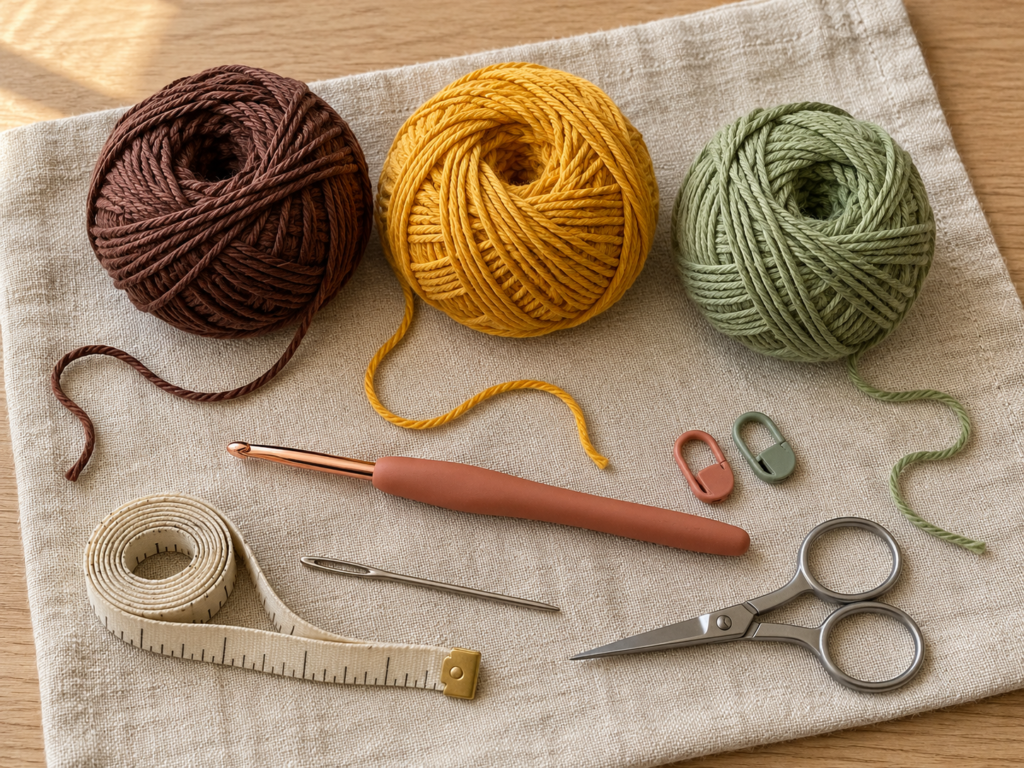
You don’t need a large yarn stash or specialty supplies for this project. One small ball of each color will make several sunflowers, depending on your yarn weight and flower size.
| Material | Recommended choice |
|---|---|
| Brown yarn | Dark cocoa-brown DK cotton yarn |
| Yellow yarn | Warm golden-yellow DK cotton yarn |
| Crochet hook | 3.5 mm (E/4) |
| Scissors | Small sharp craft scissors |
| Yarn needle | Blunt tapestry needle |
| Stitch marker | Optional, useful for counting |
| Measuring tape | Optional, for checking finished size |
| Blocking supplies | Optional rustproof pins and a foam mat |
Why cotton yarn? Cotton produces clear stitches, holds a defined petal shape, and is usually easy to wash. This makes it a practical choice for decorations that will be attached to bags, blankets, or clothing.
Acrylic yarn also works. It generally creates a softer, sometimes puffier flower, especially if the yarn has a little loft.
Try to keep both colors the same weight. Mixing a very thin brown yarn with a chunky yellow yarn can make the petals disproportionately large.
Crochet Abbreviations Used
This pattern uses US crochet terminology.
| Abbreviation | Meaning |
|---|---|
| ch | Chain |
| sc | Single crochet |
| hdc | Half double crochet |
| dc | Double crochet |
| tr | Treble crochet |
| sl st | Slip stitch |
| st / sts | Stitch / stitches |
| rep | Repeat |
| MR | Magic ring |
| RS / WS | Right side / wrong side |
If you’re familiar with UK crochet instructions, remember that a US double crochet is a UK treble, while a US treble is a UK double treble.
A quick reminder of the taller stitches
To make a US double crochet (dc), yarn over once, insert your hook into the stitch, pull up a loop, yarn over and pull through two loops, then yarn over and pull through the remaining two.
For a US treble crochet (tr), wrap the yarn twice around the hook before inserting it. After pulling up a loop, yarn over and pull through two loops three times.
The treble is taller than the double crochet, which is exactly what we need for the middle of the sunflower petal.
Before You Start
Choose your yarn colors
The traditional pairing is a dark brown center with golden-yellow petals. It’s a beautiful contrast because the darker center makes the lighter petals stand out.
For a more natural sunflower, try chocolate brown and warm mustard. If you prefer a brighter look, a deep espresso center with lemon-yellow petals works nicely.
You can also use two slightly different shades of yellow in separate flowers to create a coordinated collection.
Do you need to check gauge?
Not precisely. This is a decorative motif rather than a fitted garment, so there is no strict gauge requirement.
However, consistent tension matters because it helps all eight petals look similar. If you switch between very tight and very loose stitches, some petals may be taller or wider than others.
With DK cotton and a 3.5 mm hook, expect a flower roughly 7–9 cm across. This is an estimate, not a tested fixed dimension.
Understand the center construction
Our brown sunflower center is made from one round of 16 double crochet stitches inside an adjustable magic ring.
Instead of adding several rounds of increases, we’re keeping the center relatively compact. This gives the eight surrounding petals a prominent, full appearance.
When you finish the center, you should see 16 individual stitch tops around its outer edge.
For the petals, the pattern uses those 16 stitches in groups of two:
- The first stitch holds the group of taller stitches that forms a petal.
- The next stitch holds a slip stitch, which anchors and separates the petals.
Eight groups of two stitches use the complete circle.
A beginner note about curling
A little curling while you work is normal, especially before all the petals are finished.
If your flower curls into a tight cup, relax your tension slightly or try a hook half a size larger. If the edges become excessively wavy, your stitches may be too loose or your yarn may be too heavy for the hook.
Don’t pull the working yarn tightly after every tall stitch. A little room in each stitch helps the petals sit naturally.
Step-by-Step Crochet Sunflower Tutorial
We’re ready to make the flower!
Keep your stitch marker nearby if counting stitches is difficult. Before you change colors, check your brown center carefully. Once the petals are underway, correcting a missed center stitch becomes more time-consuming.
Step 1: Make a magic ring with brown yarn
Take your dark cocoa-brown yarn and leave a tail about 15 cm (6 inches) long.
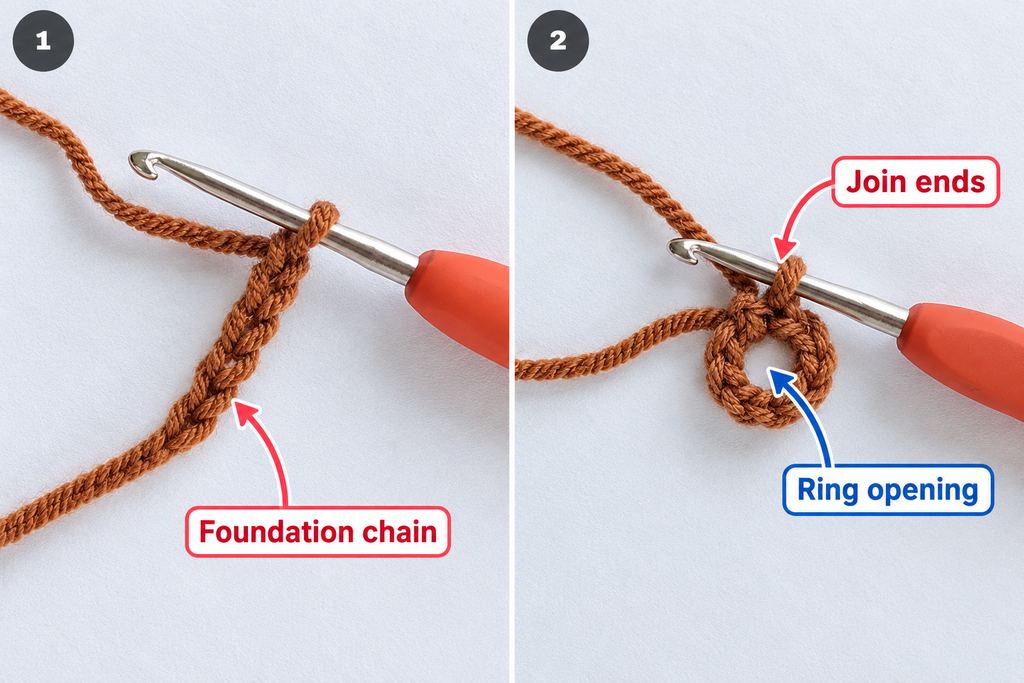
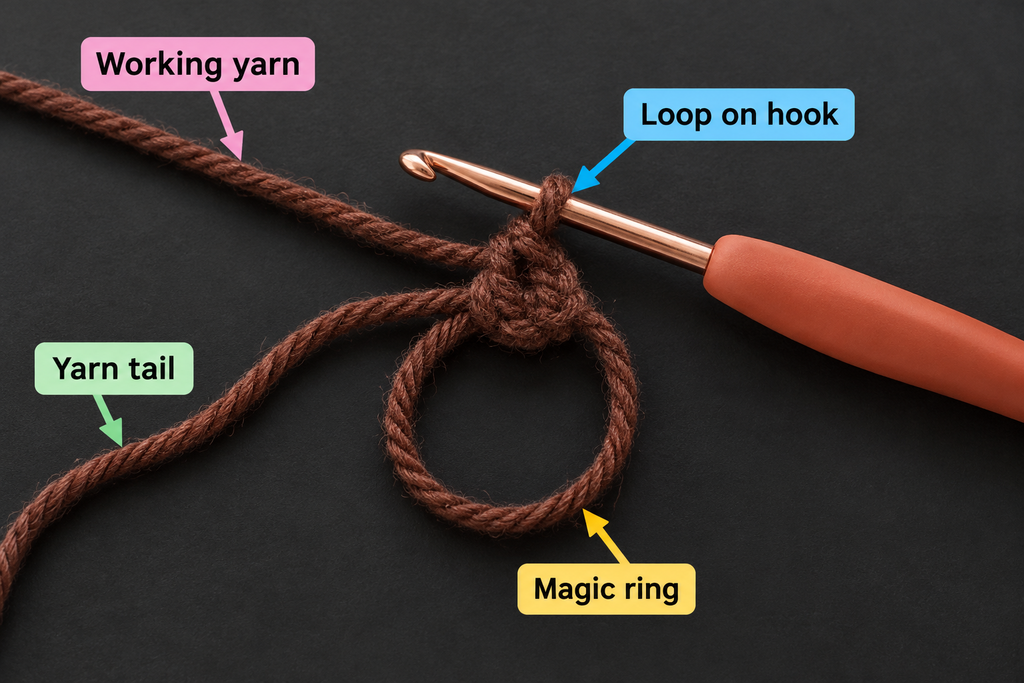
Form an adjustable loop, then insert the hook and pull a loop of working yarn through it. Chain once to secure the ring without closing its center.
You should now have a loose circle with your working yarn attached to the hook.
We’ll crochet directly into the large opening of this circle rather than into a foundation chain.
Beginner tip: Keep the ring fairly open at first. A larger opening makes it easier to insert the hook and fit all the double crochet stitches.
Common mistake to avoid: Don’t pull the starting tail before all your stitches are complete. Closing the circle too early makes it harder to work into.
Step 2: Work 16 double crochet stitches into the ring
After securing your magic ring, chain 2. This beginning chain is for height and does not count as a stitch.
Now insert your hook through the center opening and make one double crochet.
Continue working double crochet stitches into the same ring until you have 16 double crochet stitches in total.
Don’t worry if the stitches begin to crowd together. They should naturally curve around the center, forming a soft circular shape.
Try to keep the base of the stitches gathered around the ring rather than twisting around one another.
Stitch count: 16 dc.
Beginner tip: Count each completed double crochet by looking for the small V-shaped loops at the top. If you’re unsure, stop after every four stitches and count again.
Common mistake to avoid: Accidentally count the beginning chain 2 as one of the 16 stitches. In this pattern, it doesn’t count.
Step 3: Close the brown center and secure the round
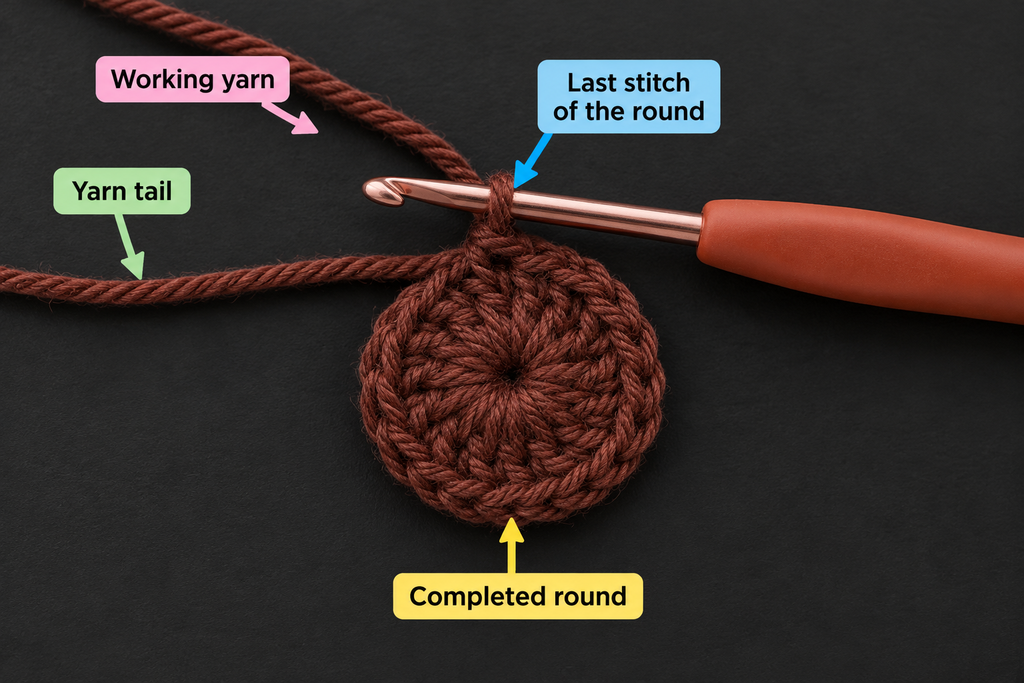
Once all 16 double crochet stitches are finished, locate the yarn tail extending from your magic ring.
Gently pull the tail until the opening in the middle closes.
You may need to hold the outside of the crochet circle with your other hand to prevent the stitches from twisting.
Next, slip stitch into the top of the first actual double crochet stitch, skipping the beginning chain 2. This joins the round.
Check the entire outside edge.
You should see 16 stitches arranged around the center and a small, neatly closed middle hole.
Cut the brown yarn, leaving a tail long enough to weave in later.
Beginner tip: If the center is slightly uneven, place it on the table and gently smooth the stitches with your fingers.
Common mistake to avoid: Joining into the beginning chain instead of the first double crochet creates an extra-looking edge. Always check the first proper stitch.
Step 4: Attach the yellow yarn for the petals
Place the brown center with the right side facing you.
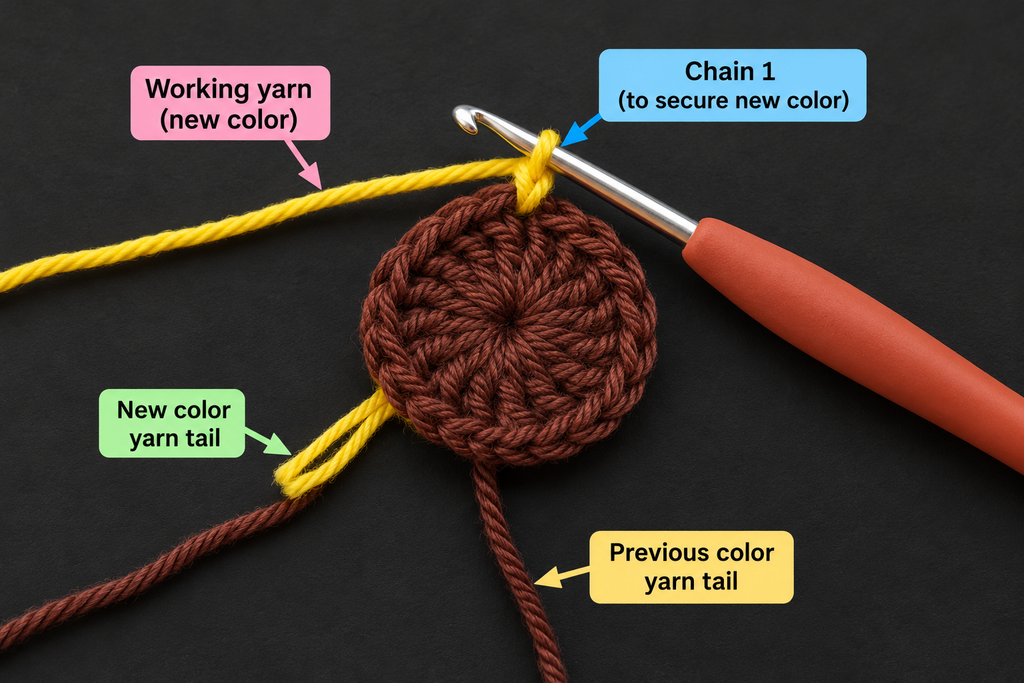
Pick any double crochet stitch along the outside edge. Insert your hook underneath both top loops of that stitch.
Take the golden-yellow yarn and pull a loop through the brown stitch.
Chain 1 to secure the new yarn. This chain does not count as part of the petal.
Hold the short yellow tail against the back of the center as you begin crocheting. You can weave it into the stitches later.
It’s helpful to place a marker in the stitch where you attached the yellow yarn. This makes it easy to identify the first petal when you return to the beginning.
Beginner tip: Attach the new color loosely enough that the first petal can sit naturally against the brown center.
Common mistake to avoid: Don’t start working into the gap between two brown stitches. The petal must be worked into a proper stitch at the outside edge.
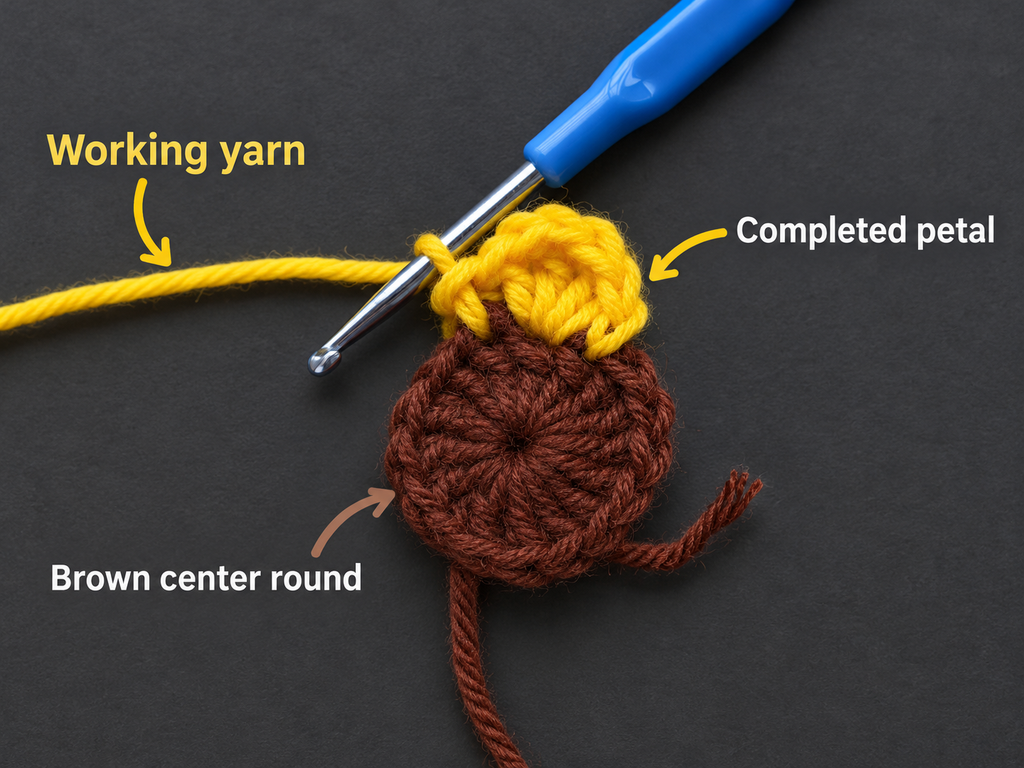
Step 5: Work the first rounded sunflower petal
Now we’re going to make the first yellow petal.
Unlike a simple loop petal, this one uses stitches of different heights to create a rounded, fuller shape.
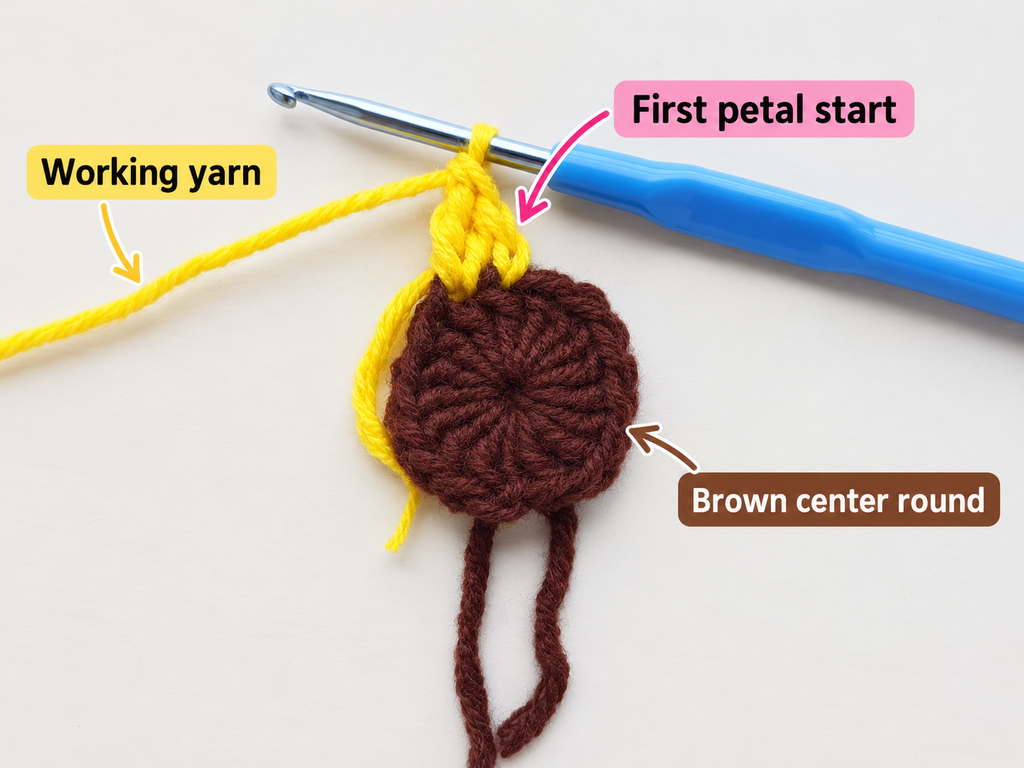
Work the following stitches into the same brown stitch where you attached the yellow yarn:
- Make 1 double crochet.
- Make 1 treble crochet.
- Chain 1.
- Make another treble crochet.
- Make 1 double crochet.
All four tall stitches are placed into the same brown base stitch. The chain 1 sits between the treble stitches and creates a little space at the highest part of the petal.
As you work, you’ll see the stitches fan outward from the brown center.
The two double crochets create slightly lower edges, while the two treble crochets give the petal its height.
Beginner tip: When making the treble stitches, keep the loops on your hook loose enough to pull through comfortably. Trebles worked too tightly can become short and stiff.
Common mistake to avoid: Don’t move to the next brown stitch between the double and treble stitches. Every stitch in this first petal group goes into the same base stitch.
Step 6: Secure the first petal with a slip stitch
With the tall stitches of the first petal complete, locate the next unused brown stitch.
Insert your hook into that stitch, yarn over, and pull the yarn through the brown stitch and the loop on your hook in one motion.
This makes a slip stitch.
The slip stitch pulls the edge of the petal back toward the sunflower center, making its rounded shape more obvious.
Look at the first petal now. It should have a higher middle and two shorter sides, with the slip stitch forming a narrow gap before the next petal.
That gap is important. Without it, the petals can merge into one continuous ruffle.
Beginner tip: After making the slip stitch, gently spread the yellow stitches with your fingertips. This helps reveal the flower shape.
Common mistake to avoid: Don’t slip stitch back into the same brown stitch that holds the tall petal stitches. The slip stitch belongs in the next stitch.
Step 7: Repeat the petal pattern around the brown center
Now comes the satisfying part: watching your sunflower bloom.
To make the next petal, move to the next unused brown stitch and work:
(1 dc, 1 tr, ch 1, 1 tr, 1 dc) in that stitch.
Then work a slip stitch into the following brown stitch.
That’s one complete petal repeat.
Continue making the same sequence around the center.
You’ll notice that each repeat uses two brown center stitches: one for the tall petal group and one for the anchoring slip stitch.
Because the center has 16 stitches, you have room for eight petals.
Count your petals as you work. After four complete petals, you should be approximately halfway around the brown disc.
You should not need to increase, decrease, or add extra chains between the petals.
Beginner tip: After every second petal, flatten the flower gently against the tabletop and check the height of the petals. If one appears much taller, compare the number of treble stitches.
Common mistake to avoid: Forgetting to work the final double crochet in a petal. This creates a lopsided shape because one side is shorter than the other.
Step 8: Check your stitch placement before the last petal
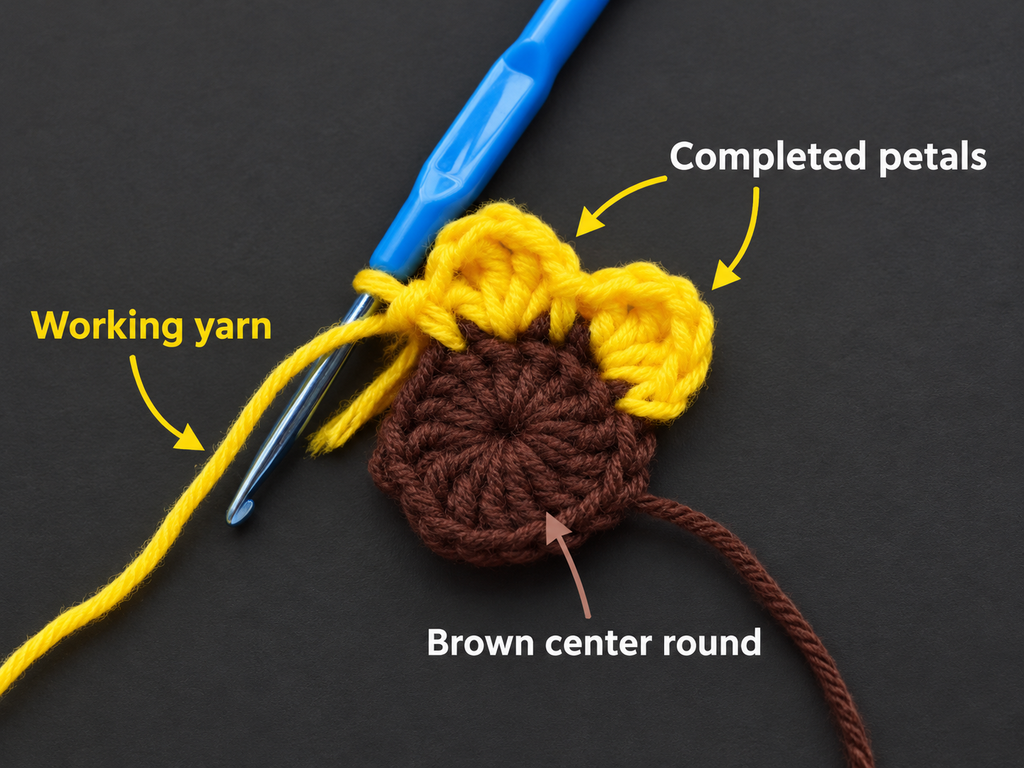
Before making the eighth petal, pause and check your work.
You should have seven finished yellow petals, each separated by a narrow slip-stitch anchor.
The last two unused brown center stitches should be available for your final repeat.
Look closely at the top of the brown center. The V-shaped stitch loops should still be visible in the unused area.
Sometimes the last few stitches become harder to recognize because the yellow petals overlap them slightly. You can gently push the previous petal aside to uncover the next stitch.
If you have too many stitches remaining, check whether you skipped a brown stitch when anchoring an earlier petal.
If you don’t have enough stitches, count your finished petals and check for a missed or doubled stitch.
Beginner tip: Use a small stitch marker to identify the next available stitch when working near the beginning of the round.
Common mistake to avoid: Don’t squeeze a petal into a gap just to make the round finish. Find and correct the counting mistake instead.
Step 9: Finish the final sunflower petal
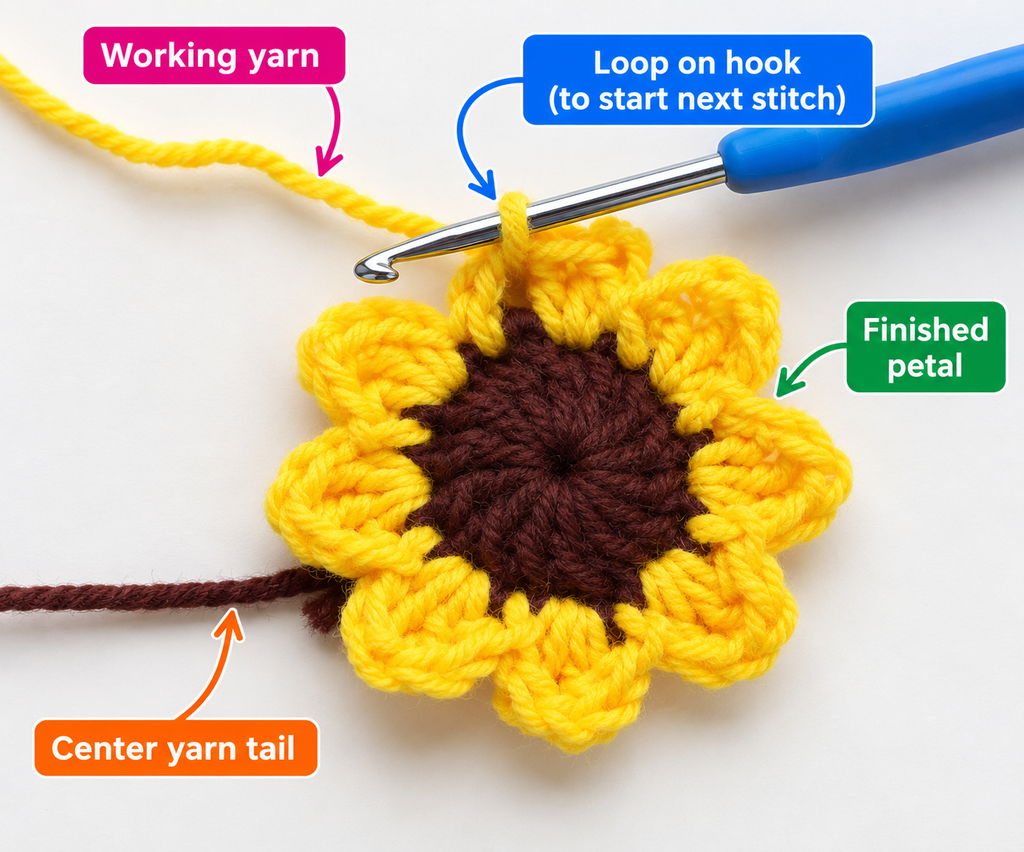
Work your eighth and final petal exactly as before.
Make a double crochet, treble crochet, chain 1, treble crochet, and double crochet into the next available brown stitch.
Then slip stitch into the final brown stitch.
At this point, all 16 brown center stitches have been used.
Your sunflower should now have eight separate, rounded yellow petals arranged around the brown center.
There is no need to add an extra petal or a second round of yellow stitches.
Cut the working yellow yarn, leaving a tail about 15 cm long. Pull the cut end completely through the final loop and gently tighten to secure.
Beginner tip: Before you cut the yarn, count all eight petals and check that none has folded underneath another.
Common mistake to avoid: Pulling the final loop so tightly that it distorts the last petal. Secure it firmly without cinching the fabric.
Pattern Notes and Stitch Counts
Here’s a quick reference for the sunflower’s construction.
| Section | Instructions | Result |
|---|---|---|
| Center | MR, ch 2, 16 dc, join to first dc | 16 center stitches |
| Color change | Join yellow yarn into any dc, ch 1 | Petal yarn attached |
| Petal repeat | (dc, tr, ch 1, tr, dc) in next center stitch, sl st in following stitch | 1 petal |
| Repeat count | Repeat petal sequence 8 times total | 8 petals |
| Finish | Fasten off and weave in ends | Completed flat appliqué |
Starting-chain rule: The beginning chain 2 in the brown round is not counted as a double crochet. The chain 1 after attaching yellow is also not counted as a petal stitch.
Round rule: The center is worked in one joined round. The petals are worked continuously around the edge without turning.
Right side and wrong side: The right side faces you while the petals are made. Weave most of the loose ends into the wrong side.
Repeat rule: Every petal uses two consecutive stitches from the brown round, so eight repeats use all 16.
Size adjustments: Changing yarn thickness and hook size is the easiest way to make the flower larger or smaller without changing the repeat. If you want a much larger center with more petals, that requires a different stitch-count arrangement.
Common Beginner Mistakes and How to Fix Them
Even a small crochet flower can behave unexpectedly. Most problems are easy to fix once you know what to look for.
1. The brown center has a hole
A small opening usually means the magic ring wasn’t pulled completely closed.
Thread the starting tail onto your yarn needle and gently tighten the circle from the wrong side. Secure the tail carefully so the opening doesn’t return.
If the center remains loose, check whether you accidentally crocheted into a chain ring instead of an adjustable magic ring.
2. There are only seven petals
This usually happens when two brown stitches are used for one petal or a slip stitch accidentally skips a stitch.
Count the brown foundation stitches and check that you started with 16. Each petal must use one base stitch for its tall stitches and one base stitch for its slip-stitch anchor.
If the count is incorrect, unravel only as far as necessary.
3. The petals have different heights
The most common cause is inconsistent stitch placement or accidentally replacing a treble with a double crochet.
Each petal must have the same combination: double crochet, treble, chain one, treble, double crochet.
Slow down during the taller stitches and check that you are pulling through the correct number of loops.
4. The sunflower curls upward
Some curling is normal, but strong curling may indicate that your stitches are too tight.
Try relaxing your tension and avoid pulling the yellow yarn tightly when anchoring the petals.
Cotton yarn often settles after a little gentle shaping or wet blocking.
5. The petals look overly ruffled
Ruffling can happen when you use yarn that is much thicker than the hook is designed for or when the tall stitches are excessively loose.
Check that both yarns are a similar weight and that you’re following the specified number of stitches per petal.
6. The yellow color change looks messy
Loose yarn tails near the edge can make the center look untidy.
Keep the new yarn tail at the back of the motif while working the first petal. When finished, weave that tail through matching stitches on the wrong side rather than tying a large knot.
7. The flower won’t lie flat
Try laying the flower on a flat surface and gently spreading the petals.
If the stitches are otherwise correct, light blocking may solve the issue. For cotton yarn, a little water and shaping are often enough.
Don’t stretch so much that you distort the center or create gaps.
How to Customize Your Crochet Sunflower
Once you’ve made the first flower, it’s easy to create several variations.
Make a smaller sunflower
Use sport-weight cotton or fine crochet thread with an appropriately smaller hook.
The stitch sequence can stay the same, but the flower will become smaller and more delicate. This works well for hair accessories and lightweight decorations.
Make a larger sunflower
Try worsted-weight cotton with a hook suitable for your yarn and tension.
Thicker yarn gives the petals more body and produces a larger appliqué without requiring additional center rounds.
Experiment with autumn colors
Sunflowers don’t have to be bright yellow.
Try combinations such as burnt orange and dark brown, mustard and cinnamon, or antique gold and espresso.
A group of flowers in these colors looks beautiful on a fall wreath or a neutral crochet blanket.
Create a flatter, softer petal texture
For a flatter look, gently block the flower after finishing.
For a softer, fuller appearance, select a smooth acrylic yarn that produces a little more volume.
Avoid heavily fuzzy yarn for your first attempt because it can make the stitches harder to see.
Add a decorative border
If you enjoy experimenting, try a narrow surface slip-stitch line around the edge of the brown center using a lighter tan yarn.
This creates a subtle outline between the center and the yellow petals.
Keep the extra stitches loose so they don’t tighten the flower.
Turn the flower into a gift
One sunflower makes a lovely addition to a birthday card, gift wrap, a fabric pouch, or a crochet bookmark.
For a small handmade gift set, make three coordinating sunflowers and sew them onto a plain cotton tote bag.
Always secure appliqués firmly when attaching them to frequently washed projects.
Finishing Instructions
A neat finish makes your sunflower look polished and helps it stay secure through handling and washing.
Step 1: Weave in the yarn ends
Turn the sunflower over so the wrong side is facing upward.
Thread the brown starting tail onto a blunt yarn needle. Pass it through several brown stitches, following the shape of the fabric rather than pulling straight across an open gap.
Change direction and weave it back through another few stitches. This helps keep the tail from working loose.
Repeat with the yellow yarn tails, keeping them within the yellow sections wherever possible.
If you’re planning to attach the sunflower to a bag or blanket, you can leave a longer tail for sewing, but make sure the other ends are secured.
Step 2: Shape the petals
Place the flower right side up on a clean tabletop.
Use your fingers to gently spread each petal. Check that none of the eight petals is tucked underneath another.
If the petal tips are curling, lightly dampen the cotton and shape the flower on a foam blocking mat.
You can use rustproof pins to hold individual petal tips in place while the flower dries.
Avoid stretching the center too much. You want a natural flower shape, not a loose mesh circle.
Step 3: Let the flower dry completely
If you’ve dampened or blocked the flower, let it dry naturally before attaching it to another project.
This prevents moisture from becoming trapped between the appliqué and the fabric beneath it.
Step 4: Attach the flower to your project
For a bag, blanket, or cardigan, thread matching yarn onto your tapestry needle and sew around the back edges of the brown center.
You can add a few discreet stitches behind the yellow petals when extra security is needed.
Try to keep the stitches invisible from the right side.
For removable items, such as a brooch, attach suitable backing hardware securely instead of sewing the flower directly onto clothing.
If the flower will be used on a young child’s item, avoid small detachable decorations and check that all attachments are secure.
Step 5: Wash and care for the sunflower
Follow the yarn label’s washing instructions.
For small cotton decorations, gentle hand washing in cool or lukewarm water is often a good choice, provided the yarn label allows it.
Reshape the flower while damp and let it dry flat.
Avoid wringing the petals aggressively because this can stretch the stitches and distort the flower.
Your Finished Crochet Sunflower
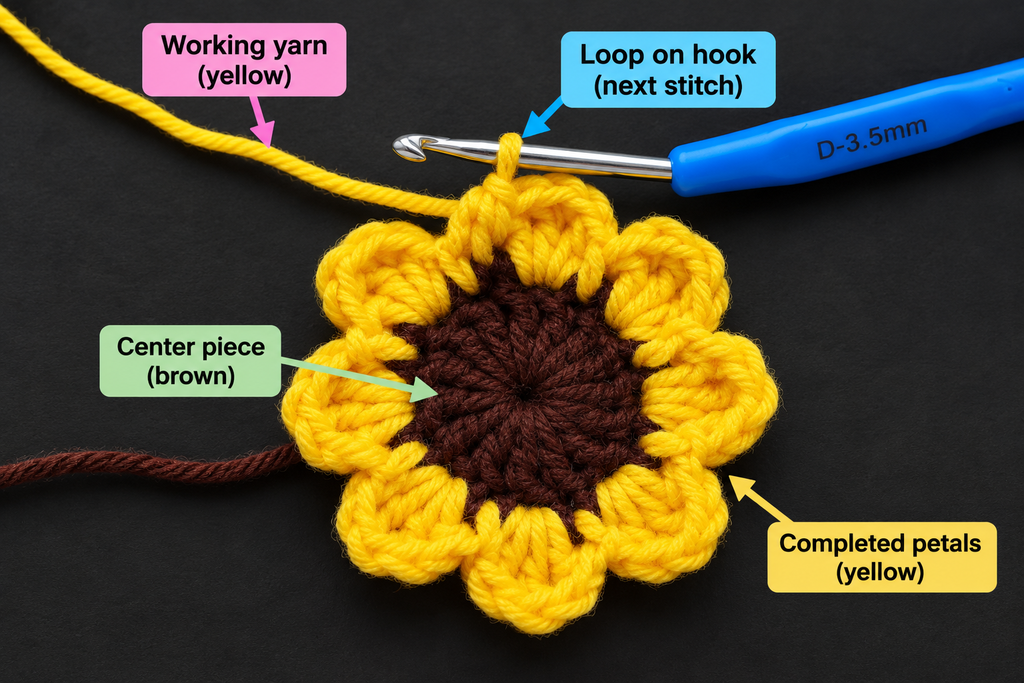
You now have a sweet little sunflower with a dark center and eight golden petals.
The finished flower should be relatively flat, with a tidy brown center and evenly separated petals around its edge.
Don’t worry if your first sunflower looks slightly different from the next one. Small differences in tension are part of handmade crochet, and after a few repeats you’ll develop a feel for keeping the petals uniform.
Quick Printable-Style Crochet Sunflower Pattern Summary
Easy Eight-Petal Crochet Sunflower
Confident beginner
30–50 minutes
Materials: Dark brown and golden-yellow DK cotton yarn, 3.5 mm crochet hook, scissors, and yarn needle.
Stitches: ch, dc, tr, sl st.
Starting method: Adjustable magic ring.
Brown center:
MR, ch 2 (does not count), work 16 dc into the ring. Pull closed, sl st into first dc. Fasten off. (16 sts)
Yellow petal round:
Join yellow yarn in any dc, ch 1 (does not count).
Work (dc, tr, ch 1, tr, dc) in the current center stitch, sl st in the next stitch. Repeat around, beginning each following petal in the next unused center stitch.
Total: 8 petals, using 16 center stitches.
Finishing: Fasten off yellow yarn, weave in ends, shape the petals, and block lightly if needed.
Estimated size: Approximately 7–9 cm wide using the suggested yarn and hook.
Frequently Asked Questions
Is this crochet sunflower pattern suitable for beginners?
Yes, especially if you already know how to make a chain and double crochet.
The center is made in one round, and every petal follows the same short repeat. Treble crochet may be a new stitch for some beginners, but you only need to learn one additional motion before continuing with the flower.
How many petals should my crochet sunflower have?
This particular pattern creates eight rounded petals.
The brown center contains 16 double crochet stitches, and each petal uses two center stitches: one for its tall stitches and one for its slip-stitch anchor.
If you want a sunflower with more petals, you’ll need a center designed to provide additional base stitches.
Can I crochet a sunflower without a magic ring?
Yes. If you’re uncomfortable with a magic ring, chain 4 and join into the first chain with a slip stitch to form a small ring.
Then work the 16 double crochet stitches into that opening.
The main difference is that a fixed chain ring cannot be tightened as completely as an adjustable magic ring, so a small center hole may remain.
What is the best yarn for a crochet sunflower?
Smooth DK cotton is an excellent choice because it creates defined stitches and holds the petals’ shape.
Worsted-weight acrylic also works well if you prefer a softer flower.
For your first attempt, choose a smooth yarn rather than chenille, eyelash, or heavily textured yarn. Clear stitch visibility makes the pattern easier to follow.
How do I keep my sunflower petals from curling?
First, check your tension. Very tight slip stitches can pull the petals inward.
Try working the anchor stitches more gently and avoid tugging the yarn after finishing each petal.
A small amount of blocking can also help cotton petals sit flatter.
Can I sew crochet sunflowers onto a blanket?
Absolutely. These sunflowers make lovely blanket appliqués.
Arrange the completed flowers on your blanket before sewing, and use matching yarn to stitch them securely in place.
Make sure loose yarn ends are woven in carefully, especially for items that will be washed regularly.
For baby blankets, ensure that no small pieces or embellishments can detach.
Can I make sunflower earrings or a sunflower keychain with this pattern?
Yes, although you may want to change the yarn size.
For earrings, use fine cotton thread and a smaller hook to create delicate flowers. Attach the finished motifs to suitable jewelry findings.
For a keychain, DK or worsted cotton will give a sturdier result. Reinforce the attachment point rather than connecting the metal ring to just one loose stitch.
Conclusion
A crochet sunflower is one of those small projects that brings a lot of satisfaction in very little time.
With just two yarn colors and a few familiar stitches, you can make a cheerful flower for bags, blankets, accessories, and handmade gifts. Once you understand the center and petal repeat, it’s easy to crochet several matching flowers without checking every instruction.
Try making one sunflower in traditional golden yellow, then experiment with softer mustard, burnt orange, or warm cream.
And if you enjoyed this project, save the tutorial to your crochet Pinterest board so it’s easy to find the next time you need a quick handmade decoration.